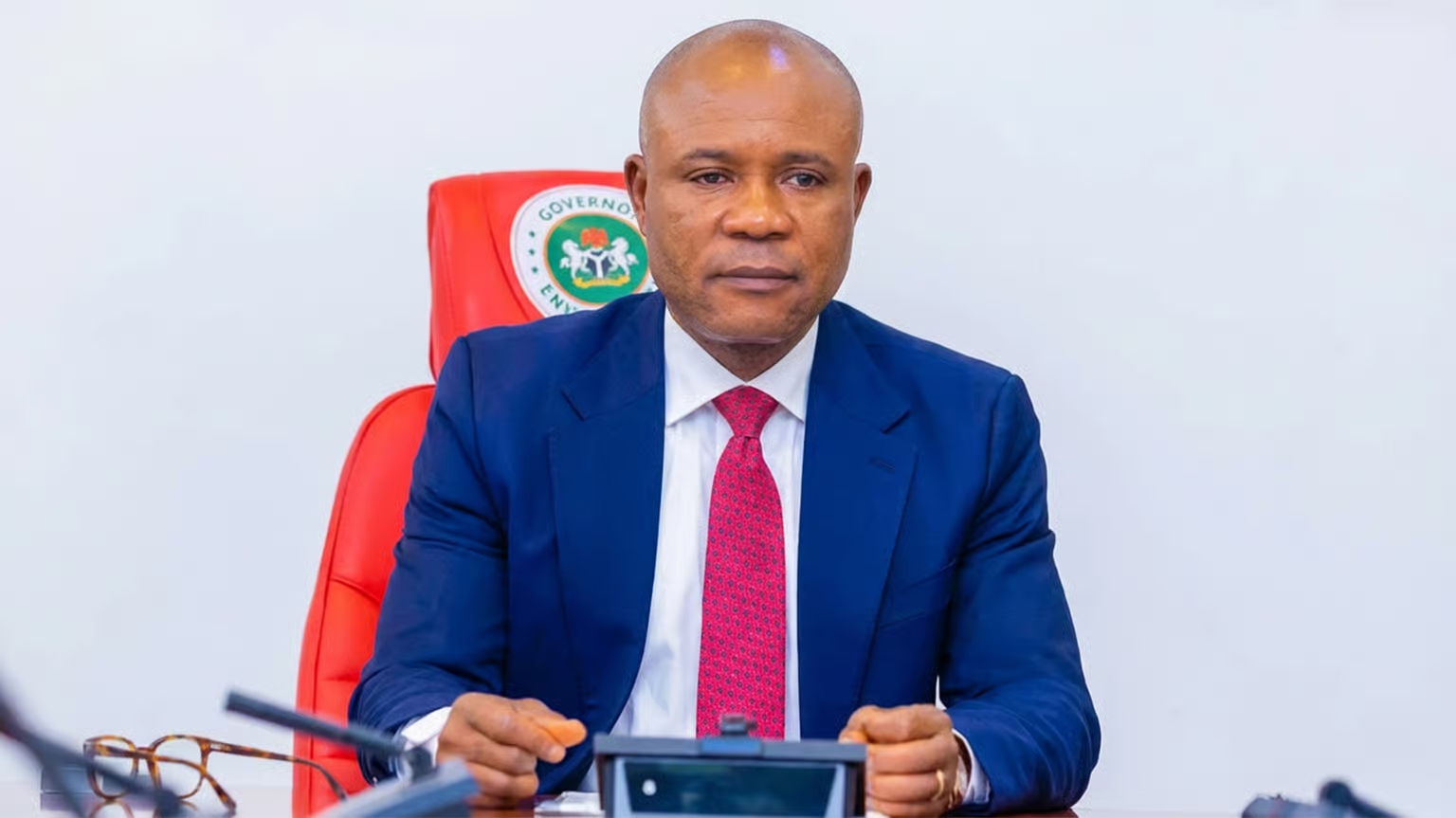
In just three years, Enugu State transformed its revenue profile by a staggering 1,400% from
N26.8 billion in 2022 to N406.7 billion in 2025. Governor Peter Mbah’s administration has been
celebrating this “fiscal resilience” as evidence of sound economic management and digital
transformation.
But beneath these impressive numbers lies a troubling reality: as tax collectors crisscross the
state extracting unprecedented revenues from struggling businesses and residents, public
school children sit on bare floors, hang on windows to attend classes, and watch N266.7 billion
allocated for “Smart Schools” that remain largely unbuilt while their crumbling classrooms
receive not a single naira.
This is the story of a state that chose to tax its way to revenue growth while abandoning the
basic educational infrastructure that serves the majority of its children.
The Tax Explosion: From N26.8bn to N406.7bn in Three Years
When Governor Peter Mbah assumed office in May 2023, Enugu State’s Internally Generated
Revenue (IGR) stood at N26.8 billion. By the end of 2025, that figure had skyrocketed to N406.7
billion, a 1,400% increase that ranks among the most aggressive revenue drives in Nigerian
state history.
The breakdown reveals how this was achieved:
● 2022: N26.8 billion total IGR
● 2023: N37.4 billion (39% increase)
● 2024: N180.5 billion (383% increase)
● 2025: N406.7 billion (125% increase over 2024)
Tax revenue specifically grew 72% year-on-year, from N30 billion in 2024 to N51.5 billion in
2025, according to Emmanuel Nnamani, Chairman of the Enugu State Internal Revenue Service
(ESIRS).
For 2026, the state has set an even more audacious target: N870 billion.
The Human Cost: “One of the Costliest States to Live In”
While the government celebrates these numbers, residents and businesses are buckling under
the weight of what critics call “tax terrorism.”
The National Bureau of Statistics recently listed Enugu State as “one of the costliest states in
Nigeria to live in” a direct consequence of the aggressive taxation regime.
Multiple Taxation Complaints
In April 2025, the Ohanaeze Youth Council (OYC) condemned what it described as “anti-people”
policies that are “crippling businesses and stifling the economic wellbeing” of residents.
According to OYC State Chairman, Comrade David Ani:
“From ESWAMA levies to land use charges, rent taxes and duplicative fees on properties, the
people of Enugu are being suffocated under the weight of a tax regime that offers them nothing
in return.”
The taxation sweep has been comprehensive and, at times, bizarre:
● Shop taxes and home taxes charged to the same individuals
● Land use charges on residential and commercial properties
● Rent taxes on tenants
● ESWAMA levies (Enugu State Waste Management Authority)
● Even taxes on corpses in mortuaries, a policy that sparked public outrage in early 2026
Chidera Nwangwu, a hotelier, told The Guardian in August 2025:
“The pressure to meet government levies and taxes is not only impacting negatively on
improved staff welfare but also limiting expansion.”
Business Environment Under Siege
The Guardian reported that across Enugu State, it has become common to see:
● Bills and notices of sanctions posted on public and private buildings
● Red tapes and padlocks slammed on business premises until the levies are paid
● Uniformed and non-uniformed revenue officials “criss-crossing the state”
The government’s response? Denial and deflection.
Governor Mbah claims the state has not increased tax rates and that the IGR growth comes
from “technology deployment, e-payment, widening of the tax net, and blocking revenue
leakages.”
Yet when pressed on the complaints, he set up a review committee in October 2025, a classic
delaying tactic while the tax machine continued its relentless march toward the N870 billion
target.
The Education Scandal: N266.7bn for “Smart Schools” Nobody Uses
While extracting hundreds of billions from residents and businesses, the Mbah administration
has created one of the most glaring contradictions in Nigerian education policy.
The Smart Schools Mirage
In 2025, the Enugu State government budgeted N266.7 billion for constructing 260 “Smart
Schools” across the state’s 260 electoral wards, plus an additional 200 Integrated Model Smart
Schools.
The promise was revolutionary: state-of-the-art facilities with:
● Interactive digital whiteboards and tablets
● AI and robotics labs
● E-libraries
● Renewable energy sources
● Smart farms
● 25 digitally connected modern classrooms per school
● Free uniforms, books, meals, and tablets for every child
Governor Mbah called it his “covenant with the Enugu child” and his “most personal and
transformative project.”
The Reality: One School Functional, Billions Gone
Nearly two years into the project, the reality is devastating:
Only one Smart School, located in Owo, Nkanu East LGA, is currently functional out of the 260
targeted.
According to a July 2025 investigation by Nigeria Education News:
● Most construction sites remain unfinished or inactive
● Some have yet to go beyond the foundation stage
● Others have become subjects of community disputes
● One contractor was allegedly paid N220 million as advance mobilisation, resides in the United States, and has yet to complete even the foundation, two years later
Many contracts were reportedly awarded to individuals with close ties to government officials, raising serious questions about procurement transparency.
Meanwhile, Existing Schools Crumble
Here’s the scandal that should outrage every Enugu parent and taxpayer:
The 2025 Budget Appropriation allocated ZERO for improving infrastructure in existing public
schools.
Investigations by WITHIN NIGERIA and Sahara Reporters revealed the shocking state of public
education in Enugu:
- Students hanging on windows and doors to attend classes due to overcrowding
- Children sitting on bare floors in schools without desks or chairs
- Teachers hanging on doors to deliver lessons due to a lack of space
- Classes are conducted outside or under trees in schools with collapsed roofs
- No toilets in many schools
- Lack of basic furniture, students sharing desks, and no personal lockers
According to a 2023 Universal Basic Education Commission (UBEC) report:
More than 50% of public primary schools in Enugu State lack basic infrastructure such as
chairs, toilets, and roofs.
The Irony: Destroying Schools to Build “Smart Schools”
Perhaps the cruelest twist: in many areas where Smart Schools are supposedly being
constructed, existing classroom blocks were pulled down to make way for the snail-paced
construction.
At Central School Ogbodu-Aba in Udenu Local Government, the government chose to build on
the school’s football field rather than utilise a nearby dilapidated primary school structure,
despite pleas from community leaders and youths.
Children who once had functional classrooms now have neither: their old schools demolished,
their new “Smart Schools” unbuilt.
Where Did the N266.7 Billion Go?