The Wike PDP faction re-elects leaders decision has reinforced internal alignments within the Peoples Democratic Party, as a group linked to Nyesom Wike returned Abdulrahman Mohammed and Samuel Anyanwu to key leadership positions. The move reflects ongoing divisions within the party as stakeholders position ahead of the 2027 general elections.
The Peoples Democratic Party has experienced internal disagreements over leadership and direction, resulting in the emergence of different blocs within its structure. These divisions have led to parallel meetings and competing decisions by factions.
The Wike PDP faction re-elects leaders development comes at a time when political parties are gradually strengthening internal structures ahead of future electoral contests. Leadership positions within party hierarchies remain critical for coordination, strategy, and candidate selection.
Nyesom Wike, Minister of the Federal Capital Territory and a key figure within the party, has continued to play a central role in shaping discussions among his aligned stakeholders.
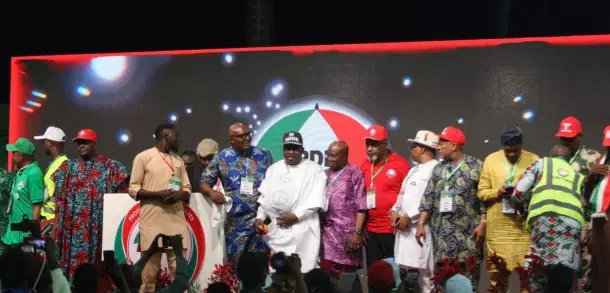
At the factional gathering, Abdulrahman Mohammed was re-elected as National Chairman, while Samuel Anyanwu retained his position as National Secretary. The exercise was conducted among party members aligned with the Wike-led bloc.
Participants at the meeting reaffirmed their support for the leadership, describing the process as a continuation of the faction’s organisational structure.
The outcome of this re-election signals an effort to maintain continuity within the group, despite broader disagreements within the party.
The event also reflects ongoing engagements among party stakeholders as different factions continue consultations on leadership and strategy.
The Wike PDP faction re-elects leaders decision highlights the persistence of factional dynamics within the PDP. For party members, this may influence internal coordination and the ability to present a unified structure in future political activities.
For political observers, such developments provide insight into the evolving power balance within the party and the role of influential figures in shaping outcomes.
In a broader context, internal party stability is often linked to electoral performance, policy direction, and stakeholder confidence, particularly in Nigeria’s competitive political landscape.