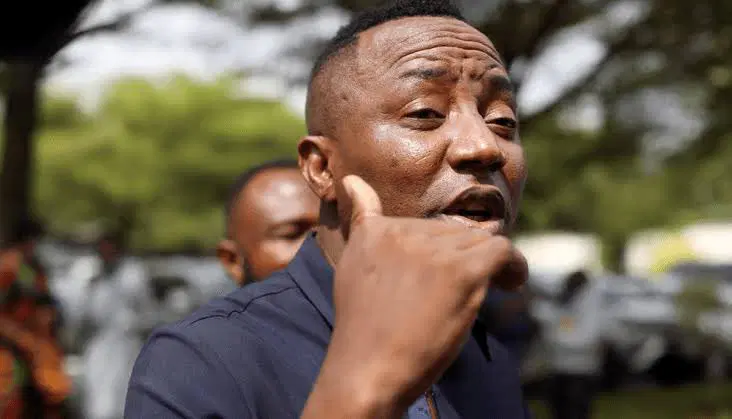
The Department of State Services (DSS) has denied responsibility for the remand of activist and Sahara Reporters publisher Omoyele Sowore at the Kuje Custodial Centre, maintaining that the decision was made entirely through judicial processes.
The clarification follows growing public debate surrounding the circumstances that led to Sowore’s detention after proceedings at the Federal High Court in Abuja. In a statement released on Wednesday, the agency said the Sowore remand controversy stemmed from court decisions and not from any action initiated by the DSS.
The statement was signed by the Deputy Director of Public Relations and Strategic Communications at the DSS National Headquarters, Favour Dozie. According to the agency, the Director-General of the DSS, Adeola Ajayi, has also ordered an investigation into the conduct of operatives seen in videos recorded at the Federal High Court on June 22.
The agency acknowledged public concerns over videos showing Sowore involved in an altercation with an official of the Nigerian Correctional Service and what appeared to be a confrontation involving DSS personnel. While noting that Sowore eventually entered a DSS vehicle instead of a Nigerian Correctional Service vehicle after the incident, the agency said an immediate investigation had been initiated to determine whether any personnel acted improperly.
“From the foregoing, it is clear that the issues which led to the revocation of his bail and his subsequent remand arose entirely from court processes, as the Service neither arrested him nor opposed his bail application,” the statement said. The DSS emphasized that the revocation of Sowore’s bail and his subsequent detention were judicial decisions arising from ongoing legal proceedings.
Addressing the background to the prosecution, the DSS said the matter originated from social media posts made by Sowore on August 25, 2025, concerning President Bola Tinubu following remarks attributed to the president during a visit to Brazil. The agency stated that it initially sought a non-confrontational resolution rather than pursuing an arrest.
“Rather than resort to arrest, the Service, in a letter dated 4th September 2025, demanded a retraction within one week,” it stated.
According to the DSS, the case was eventually filed under Section 24 of the Cybercrimes (Prohibition, Prevention, etc.) (Amendment) Act, 2024, through Suit No. FHC/ABJ/CR/481/2025 to allow the court determine whether Sowore’s comments violated the law. The agency argued that the Sowore remand controversy should be viewed within the broader context of its preference for resolving disputes through legal channels rather than arrests.
To support its position, the agency referenced several previous cases where it sought judicial interpretation instead of direct enforcement measures. Among the examples cited was litigation concerning Prof. Pat Utomi’s Shadow Government initiative.
“Specifically, in the case of Prof. Pat Utomi’s Shadow Government, the Service sought judicial clarification without making any arrest or issuing any invitation. The Federal High Court subsequently declared the Shadow Government unconstitutional,” the statement added.
The DSS also pointed to previous disputes involving reports about the Lagos State House of Assembly and the National Assembly Complex, noting that it sought public corrections rather than arrests.
The agency further stressed that Sowore was granted bail on self-recognition at the commencement of the trial and that it did not oppose the application. As the Sowore remand controversy continues to attract public attention, the DSS said it remains committed to professionalism, lawful procedures, and resolving disputes through the courts while respecting the rule of law.