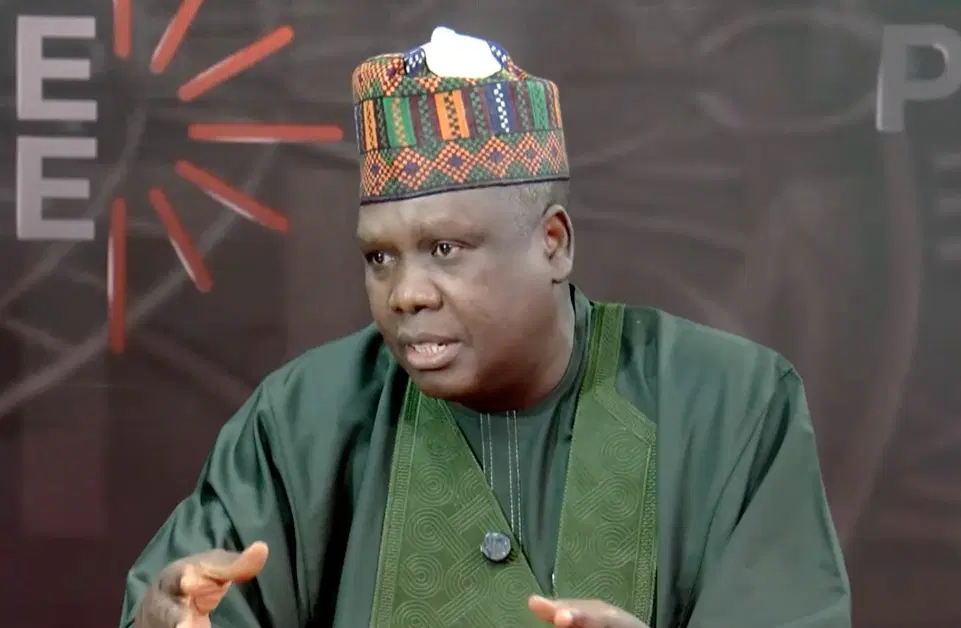
Special Adviser to President Bola Tinubu on Policy Communication, Daniel Bwala, has argued that Cardinal John Onaiyekan’s recent remarks on Nigeria’s economy and governance reflected the position of the Catholic Church rather than the wider Christian community.
Bwala made the remarks in a post on his X account while responding to reactions that followed Onaiyekan’s television interview after members of the Catholic Bishops’ Conference of Nigeria met with President Tinubu at the Presidential Villa. The presidential aide maintained that the Cardinal’s comments should be viewed within the context of the Catholic Church’s position and not as the collective opinion of Christians across the country.
Commenting on the controversy, Bwala alleged that the Catholic institution had openly supported Labour Party presidential candidate Peter Obi during the 2023 general election, arguing that this political background was relevant to interpreting the Cardinal’s statements.
“Cardinal Onaiyekan wasn’t speaking for Christians; he was speaking for Catholics, the very institution rooting for Peter Obi. In fact, likely the institution where Peter Obi also said in 2022, ‘Take back your country.’ Therefore, Cardinal is more political than spiritual,” Bwala stated.
He, however, stressed that not every member of the Catholic Church shared the same political preference, noting that the Cardinal’s position should not automatically be taken as the opinion of all Catholic faithful.
Addressing the disagreement between President Tinubu and the Catholic bishops over the country’s economic situation, Bwala said the President was justified in rejecting the assessment presented during the meeting. According to him, Tinubu’s position was based on official economic indicators and available national data.
“The President was well within his right to disagree with their assertion as regards Nigeria’s economy based purely on facts, statistics and numbers put into context,” he said.
Bwala maintained that differing opinions on national issues are expected in a democratic setting and should not be interpreted as hostility.
The presidential spokesman also questioned what he described as inconsistencies in some religious teachings, suggesting that certain clerics often encourage believers to remain optimistic despite personal hardships.
He further argued that Christianity in Nigeria extends beyond the Catholic Church, insisting that broader Christian bodies representing multiple denominations should remain politically neutral. According to him, organisations that bring together various Christian denominations, including Catholics, ought not to become platforms for partisan political engagement.
“There is a body comprising all Christians, including the Catholics and Catholic Bishops Conference, and that body’s position is neutral and should be so; otherwise, it is political,” Bwala added.
His comments come amid continued public debate over the exchange between President Tinubu and members of the Catholic Bishops’ Conference, who recently expressed concerns about Nigeria’s economy, insecurity and democratic institutions during their meeting with the President.