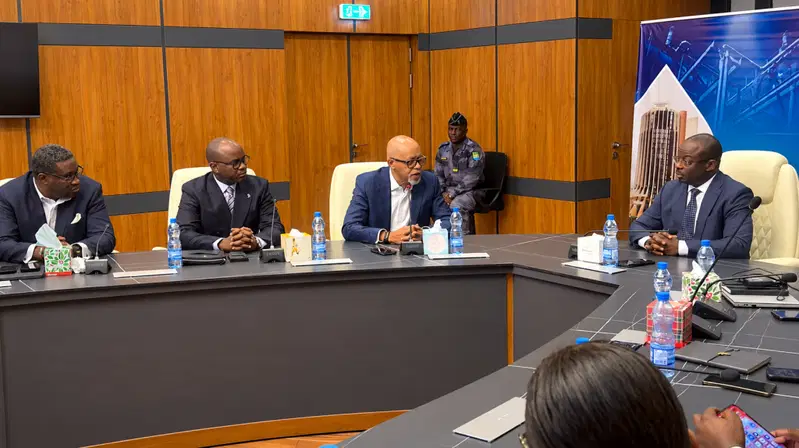
Nigerian energy infrastructure company Oilserv Limited has entered into a partnership with the Gabonese Government to develop and commercialise hydrocarbon resources in two Gabonese blocks.
The Oilserv Gabon partnership was formalised through a Memorandum of Understanding, MoU, covering the DEF-3 and D4-5 blocks in the Gabonese Republic.
The agreement establishes a framework for developing the infrastructure needed to unlock the commercial potential of the identified hydrocarbon reserves.
The partnership comes as Gabon’s energy market is projected to reach $2.12 billion by 2031.
Under the agreement, Oilserv and the Gabonese Government will focus on developing gas transportation, compression and treatment infrastructure.
The infrastructure is expected to strengthen gas supply for thermal power generation while supporting wider industrial development in the country.
At the signing ceremony, Gabon’s Minister of Petroleum and Gas, Clotaire Kondja, signed the agreement on behalf of the government.
Kondja described the partnership as an opportunity to deepen cooperation and create additional business opportunities across Africa.
He also called for more flexible and business-friendly policies to address challenges such as skills shortages and capital flight.
According to the minister, attracting investment, retaining capital and developing local expertise will be important to accelerating infrastructure development across the continent.
Oilserv Group Chairman and Group Chief Executive Officer, Engr. Dr Emeka Okwuosa, CON, said the agreement represents the company’s expansion into a new market.
He said the engagement places Oilserv across resource development, energy infrastructure, gas monetisation and national energy security.
“With decades of proven experience in delivering complex energy infrastructure, Oilserv brings to the partnership its integrated capabilities, technical expertise and deep understanding of Africa’s energy landscape,” Okwuosa said.
He added that the company’s role was increasingly moving beyond conventional project delivery towards integrated energy solutions across the hydrocarbon value chain.
Okwuosa said African countries were increasingly seeking to use natural resources to support industrialisation, improve energy access and strengthen economic resilience.
He said partnerships such as the Gabon engagement could therefore contribute to connecting resources with infrastructure, industries and markets.
“We are not only building infrastructure; we are helping to build the energy systems that power Africa’s future,” he stated.
The agreement follows Oilserv Group’s participation in the Africa Oil & Gas Week Energy 2026 Conference in Accra, Ghana.
During a plenary session on midstream development and gas monetisation, Engr. Chuka Eze, Managing Director of Frazimex Engineering, highlighted the need to accelerate gas infrastructure development across Africa.
Drawing on the group’s experience, Eze identified gas flaring, infrastructure shortages and commercial pressures as continuing challenges to monetising the continent’s gas resources.
He also stressed the importance of supportive policies and contractors with the technical capacity to execute complex energy infrastructure projects.
Eze advocated country-specific energy strategies based on available resources, with gas serving as a potential foundation for power generation and industrialisation where adequate infrastructure is available.
Oilserv cited its involvement in major projects including the AKK and OB3 gas pipelines as evidence of indigenous engineering capacity in the energy sector.
The company has also participated in the development of more than six power plants, including Geometric Power, as well as Lagos’ gas distribution network.
The Oilserv Gabon partnership further expands the group’s continental activities as it seeks to develop integrated energy solutions across African markets.
The company maintains that Africa’s gas resources can generate greater economic value when infrastructure connects them effectively to households, industries and commercial markets.
It said its focus remains on translating investment and industry discussions into infrastructure projects capable of supporting sustainable economic activity.