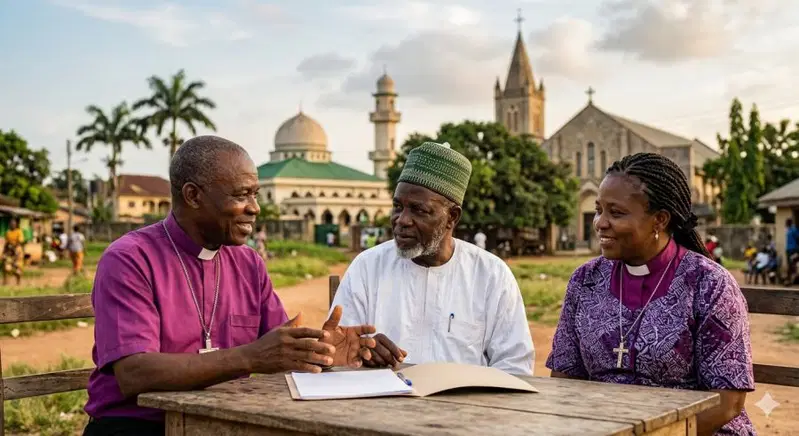
The Economic and Financial Crimes Commission, EFCC, has raised concerns over the involvement of some religious figures in religious financial crimes in Nigeria.
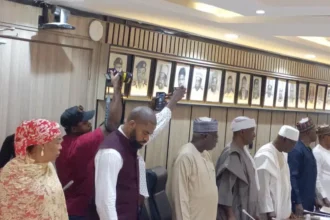
EFCC Chairman Ola Olukoyede made the disclosure on Wednesday at the 2026 Second Council Meeting of the Nigeria Inter-Religious Council, NIREC, in Abuja.
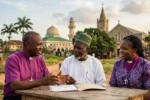
The meeting, themed “Shared Sacred Flourishing in Nigeria,” brought attention to the role of religious institutions in promoting integrity and peaceful coexistence.
Olukoyede said EFCC records contained numerous cases involving individuals identified as pastors, imams, bishops, sheikhs and other religious figures.
According to him, some of those investigated had been prosecuted and convicted, with some currently serving prison sentences.
“So many case files, pastor, imam indicted for financial crimes. And some of them are even badly convicted, and they are in jail,” he said.
The EFCC chairman expressed concern that some convicted individuals continued to be addressed by their religious titles even while serving prison sentences.
“And while in jail, they still refer to them as pastor and imam,” he added.
Olukoyede consequently called for a rethink of how religious titles are conferred, arguing that such titles should not become a barrier to accountability.
“I advocated for a review of the titles we give to men of God. Maybe, if it is possible for us to remove those titles, pastor and imam.
“If it is possible for us to remove that title: pastor, Imam, bishop, sheik. And you know what? I have my case files full of these titles,” he said.
Olukoyede said the situation should prompt reflection on what genuinely defines a religious leader.
He argued that spirituality should be demonstrated through conduct and integrity rather than appearance or self-assigned titles.
“Because the spirit of God is by their fruits, not their appearance. Not what we call ourselves. It is by the fruits,” Olukoyede said.
He also recalled an incident involving a suspect brought to the EFCC for investigation.
According to him, the individual requested to see him and introduced himself using several religious and academic titles.
“Somebody was brought in for investigation. And he demanded to see me… As he entered, he said, I am reverend, doctor, bishop,” he narrated.
Olukoyede said he ignored the titles and focused on the allegations against the individual.
He subsequently warned that religious identity would not protect anyone from prosecution over financial crimes.
“So, if you think you’re a Christian or you’re a pastor here, and you commit financial crime, I will be your enemy. I won’t be your friend,” he declared.
The EFCC chairman said the country’s strong religious culture should translate into greater integrity in public and economic life.
“We are a deeply religious people. Our churches and mosques are full,” he said.
He, however, questioned whether religious commitment was adequately reflected in the conduct of Nigerians.
“Yet, we must have the courage to ask ourselves, has the depth of our religious profession been sufficiently reflected in the integrity of our public and economic life?” he asked.
Olukoyede stressed that financial crime had no religious or ethnic identity, noting that both Christians and Muslims suffer when public resources are stolen or misappropriated.
He said religious leaders could play a significant role in changing attitudes toward corruption because their influence extends beyond places of worship.
The EFCC chairman also recalled what he described as disturbing findings from investigations into a pilgrimage board during his time as Chief of Staff and Secretary.
He alleged that almost 75 per cent of funds meant for pilgrims had been stolen.
According to Olukoyede, faith communities have an important role in preventing corruption by shaping character and encouraging honesty.
“While EFCC can investigate conduct and prosecute fraud, faith communities can influence character and cultivate honesty to prevent crime,” he said.
Olukoyede also questioned the practice of religious institutions celebrating individuals whose wealth cannot be satisfactorily explained.
He cited the example of a public servant who allegedly constructed a mosque whose value was far beyond what his legitimate earnings could reasonably support.
“A public servant says he has built a mosque that is worth more than his earnings in the next 500 years. And you go there to dedicate it. You are dedicating the process of crime,” he said.
The EFCC chairman urged religious communities to avoid providing what he described as moral shelter for corruption.
He maintained that religious, ethnic or charitable considerations should not be used to legitimise or cleanse proceeds allegedly obtained through the suffering of others.
Olukoyede said the fight against religious financial crimes therefore required both law enforcement and the influence of faith communities, with the latter helping to promote values capable of preventing financial misconduct.