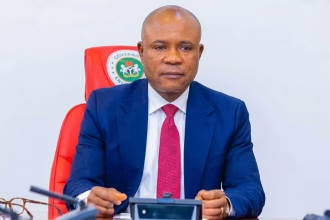

Anambra State Government and leadership of the Onitsha Main Market have reached an agreement to begin a phased remodelling of the market, aimed at improving infrastructure, organisation and sustainability while ensuring continued commercial activity, Governor Chukwuma Soludo said on Friday, January 30, 2026.
The accord followed intensive dialogue between state authorities and traders at the Government House in Awka, the state capital.
Governor Soludo said the phased approach will allow the work to proceed with minimal disruption to trading operations in the sprawling market that serves as a major economic centre for Anambra and neighbouring states.
According to the governor, the initiative is part of the administration’s broader plan to create planned and sustainable urban markets that meet modern standards.
Under the agreement, the remodelling exercise will start immediately and be implemented in stages. This is intended to reduce the impact on daily business for traders, many of whom depend on the market for their livelihoods.
Governor Soludo described the decision as “necessary leadership” to secure the future viability and competitiveness of Onitsha as one of Nigeria’s leading commercial hubs.
Key components of the planned intervention include reclaiming market parks, restoring pedestrian walkways and constructing public conveniences.
Other upgrades will involve repainting and colour-coding of shops and trading lines to improve aesthetics and ease of navigation for customers and traders alike.
The governor emphasised that the exercise aligns with his administration’s manifesto commitment to develop planned and sustainable cities, communities and markets across Anambra State. He said the phased strategy will help modernise Onitsha Market without unduly hindering economic activity.
Chief Chijioke Okpalugo, Chairman of the Onitsha Main Market, confirmed that traders accepted the government’s proposal for remodelling.
However, Okpalugo asked for a brief period to allow traders to remove goods from areas earmarked as illegal structures ahead of the intervention. This appeal reflects traders’ concerns about protecting their stock and adjusting to planned changes while maintaining continuity of business.
The decision came after weeks of tension following the temporary closure of the Onitsha Main Market, which had been ordered by the government as part of efforts to enforce resumption of trading activities previously affected by periodic sit-at-home observance. Traders’ protests and security deployment had underscored the importance of constructive engagement to resolve disputes.
Onitsha Main Market is one of West Africa’s busiest commercial centres, with thousands of traders and significant economic linkages across sectors such as electronics, fabrics, automobile parts and consumer goods.
Modernising the market is anticipated to boost investor confidence, improve safety and enhance consumer experience, factors that can underpin growth for small and medium enterprises operating in the market.
Urban planning experts have noted that infrastructure improvements in major markets help reduce congestion, improve waste management, and attract formal investment — all of which contribute to economic competitiveness in rapidly growing cities.
The agreement between the government and traders represents a significant step toward rehabilitating a key economic hub while sustaining the informal business ecosystem that supports thousands of livelihoods.
As the phased remodelling gets underway, both parties have signalled a willingness to collaborate to ensure that Onitsha Market retains its central role in regional trade while meeting modern standards of infrastructure and organisation.