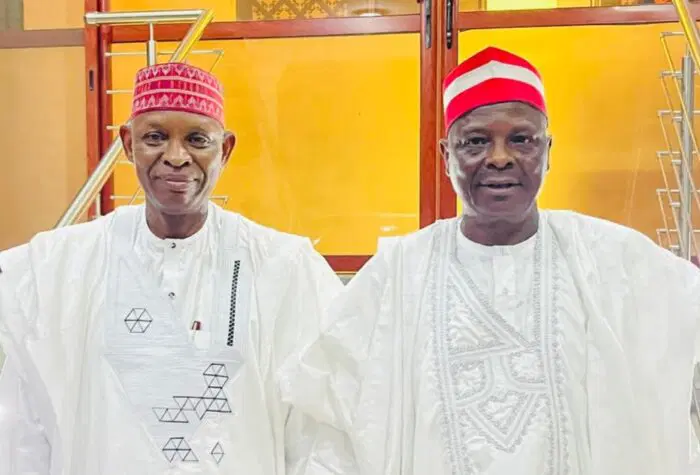
The All Progressives Congress (APC) has gained another major political figure in Kano State following assertions by the state’s Commissioner for Information and Internal Affairs, Ibrahim Waiya, that former Senator Rabiu Musa Kwankwaso has also defected to the ruling party alongside Governor Abba Kabir Yusuf, party and government sources said on Sunday, February 1, 2026.
The development reflects the continuing shift of political forces in the North-West geopolitical zone ahead of the 2027 general elections.
Waiya, speaking in an interview responding to criticisms that Governor Yusuf’s move to the APC amounts to betrayal of his founding party, the New Nigeria Peoples Party (NNPP), described the governor’s defection as inevitable given the internal crisis besetting the NNPP.
He said the governor’s political future within the NNPP was uncertain and that joining the APC aligned with a broader interest to strengthen governance and development in Kano.
Governor Yusuf formally resigned from the NNPP in January 2026 and joined the APC, a move that has reshaped Kano’s political landscape less than three years after his election under the NNPP platform.
While Waiya’s comments suggest Kwankwaso’s alignment with the APC, the NNPP National Publicity Secretary, Ladipo Johnson, denies that Kwankwaso ever engaged in talks about joining the APC, stating that the former national leader of the NNPP has not negotiated or submitted any intention to defect.
The party said suggestions otherwise are “baseless” and untrue.
Rabiu Musa Kwankwaso, a two-time governor of Kano and veteran political figure, remains a central voice in Kano politics.
Following Governor Yusuf’s exit from the NNPP, Kwankwaso publicly criticised the decision and described it as a major political betrayal that could weaken the party’s influence.
He also expressed doubts about the necessity of leaving the NNPP, insisting that internal disagreements are normal in all parties and that the NNPP continues to be viable and peaceful.
Supporters of the APC in Kano have welcomed the reported realignment, arguing that a broader political base within the ruling party will secure developmental projects and deepen cooperation with the federal government.
Analysts note that as governors and key political leaders move into the APC fold, the ruling party’s organisational strength is likely to increase in the lead-up to the 2027 elections, reflecting a broader trend of political realignments across states in northern Nigeria.
The controversy over Kwankwaso’s status illustrates the complexities of political allegiance in Nigerian politics.
While government representatives frame defection as a pragmatic decision to enhance governance and access federal support, opposition voices view such moves as undermining party integrity and grassroots loyalty.
For urban electorates and business communities in Kano, one of Nigeria’s largest and economically significant states — these political shifts could influence policy direction, governance continuity, and investor confidence.
Political analysts say that consolidations around the ruling party may improve alignment with federal policy frameworks, potentially easing bureaucratic processes for development projects and private-sector growth. However, such shifts also raise questions about intra-party democracy and the future of alternative political platforms.
As Governor Abba Yusuf’s move to the APC continues to reverberate through Kano’s political landscape, claims about Kwankwaso’s own defection highlight both the fluidity and contention inherent in Nigerian political realignments.
With conflicting accounts from government officials and the NNPP, the status of political leadership in Kano remains a key storyline to watch ahead of the 2027 elections.