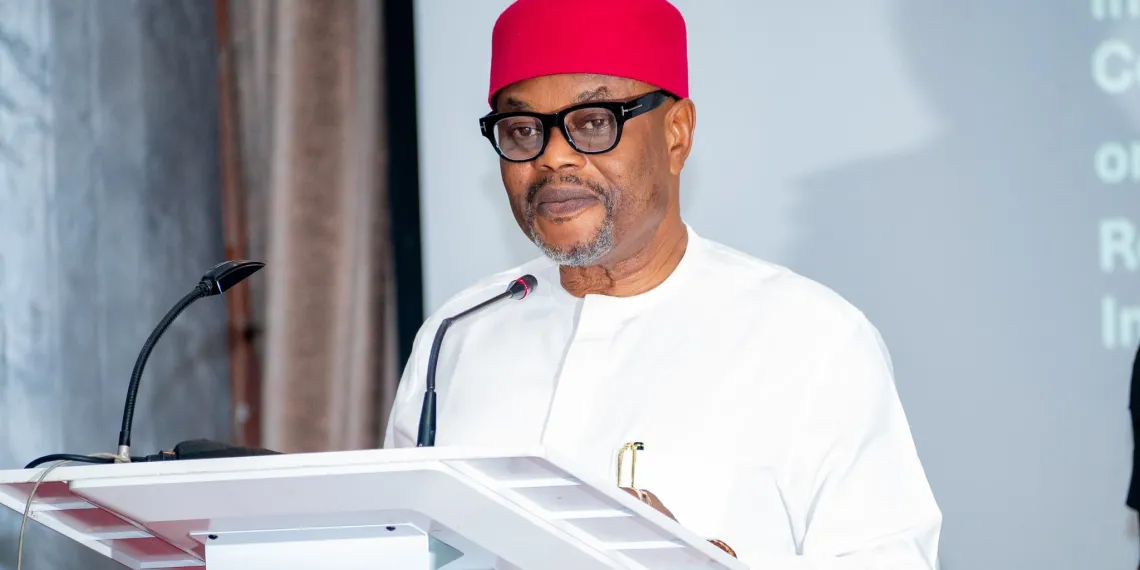
A recent article published by Premium Times titled “FG Panel Nails Uche Nnaji, Confirms Ex-Minister Forged UNN Certificate” presents what appears to be a definitive conclusion regarding the academic credentials of Uche Geoffrey Nnaji, the immediate past Minister of Innovation, Science and Technology.
The article claims that a federal investigative panel has confirmed certificate forgery involving the former minister and University of Nigeria, Nsukka.
However, a careful examination of available evidence, institutional procedures, and ongoing judicial proceedings raises serious concerns regarding the accuracy and completeness of the narrative presented.
This report examines the major gaps in the publication and clarifies the factual context currently surrounding the dispute.
The Panel Report Has Not Been Officially Released
The most critical issue in the media narrative is that the investigative report referenced by Premium Times has not been formally released by the Federal Ministry of Education.
The article claims to have obtained the report exclusively and proceeds to publish conclusions attributed to the panel.
However:
- the Ministry has not publicly confirmed the findings,
- the report has not been gazetted or officially released,
- and the alleged conclusions have not been subjected to institutional scrutiny.
Publishing conclusions from an unpublished government report raises legitimate questions about verification, context, and completeness.
Without official publication, the public cannot independently assess the report’s methodology, evidence, or conclusions.
The Panel Was Triggered by Nnaji’s Petition
The investigative panel itself was constituted following a petition submitted by Chief Uche Geoffrey Nnaji to the Minister of Education.
The petition raised allegations against the leadership of University of Nigeria, Nsukka, including:
- unauthorized access to confidential academic records,
- alleged tampering with institutional files,
- intimidation of university staff,
- and unauthorized disclosure of personal academic information.
These allegations raise potential concerns under the Nigeria Data Protection Act 2023, which imposes strict obligations on public institutions regarding the protection of personal data.
Contrary to the media narrative, the panel’s establishment was therefore linked to institutional conduct within the university, not solely to the verification of a certificate.
The Matter Is Already Before the Federal High Court
The dispute regarding Chief Nnaji’s academic records is currently the subject of litigation before the Federal High Court of Nigeria.
In this case, Chief Nnaji is the Applicant, seeking judicial relief including:
- the release of his complete academic transcript,
- protection of his academic records from alleged interference,
- and judicial review of the actions taken by university officials.
During proceedings presided over by H. J. Yilwa in February 2026, the hearing could not proceed due to procedural irregularities including missing proof of service and incomplete filings by respondents.
The matter was subsequently adjourned to allow parties to regularize their filings.
The existence of an ongoing judicial process raises an important legal principle: issues actively before a court should not be pre-judged through media narratives.
The Transcript Question Remains Unresolved
The central documentary evidence in the dispute is the academic transcript.
Chief Nnaji’s legal team has maintained that:
- requests for the transcript were made to the university as far back as May 2025,
- the university has not publicly released the document,
- and the transcript would provide definitive clarification regarding academic completion.
Because the transcript constitutes the official institutional record of academic performance and graduation status, its disclosure remains essential for resolving the dispute.
Conflicting Institutional Narratives
The controversy surrounding Chief Nnaji’s academic status has been shaped by conflicting institutional communications.
Different reports have cited:
- admissions records confirming enrollment in the early 1980s,
- university statements questioning the authenticity of the certificate presented,
- and legal filings asserting completion of academic requirements.
These contradictions demonstrate that the issue is more complex than the simplified narrative presented in some media reports.
Such disputes typically require documentary verification and judicial determination, rather than media adjudication.
The Risk of Media Trial
Investigative journalism plays a vital role in democratic accountability.
However, responsible reporting requires:
- transparency of evidence,
- contextual presentation of facts,
- and respect for due process.
Publishing definitive conclusions from an unpublished report while a matter is under judicial consideration risks creating what is commonly referred to as a media trial.
Media trials can distort public understanding by presenting allegations as established facts before institutional processes are complete.
The Institutional Stakes
The controversy extends beyond the reputation of one individual.
It raises broader questions regarding:
- governance within public universities,
- the integrity of academic records management,
- compliance with national data protection laws,
- and transparency within public institutions.
As one of Nigeria’s most respected universities, University of Nigeria, Nsukka, founded by Nnamdi Azikiwe, has a responsibility to ensure that disputes involving its records are resolved through transparent and verifiable procedures.
Conclusions
In a constitutional democracy governed by the rule of law, allegations, no matter how widely circulated, do not substitute for institutional due process.
The final determination of this matter must therefore rest with the appropriate authorities and the courts.