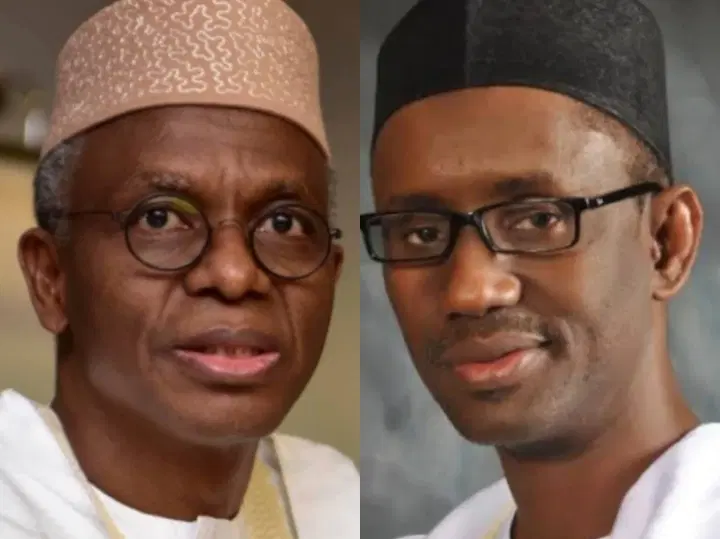
A former political adviser to President Olusegun Obasanjo says a secret public opinion poll conducted by Bola Tinubu helped position Nuhu Ribadu ahead of Nasir El-Rufai in the 2011 ACN presidential nomination, an event he links to the long-standing political rift between the two men.
The account comes from Akin Osuntokun, who served as Political Adviser under President Obasanjo and was Director-General of the 2023 Labour Party Campaign Council.
In an interview aired on Arise News PRIME TIME, Mr Osuntokun discussed the history of the relationship between El-Rufai, Ribadu, and Tinubu dating back to 2006–2007, when political alignments were forming ahead of national leadership transitions.
At that time, a caucus of Obasanjo’s political appointees, including El-Rufai and Ribadu, was formed to guide an exit strategy as Obasanjo prepared to leave office.
Within that group, El-Rufai and Ribadu were considered potential presidential successors in the then emerging political climate.
Mr Osuntokun said the caucus was convened to offer advice on managing media relations and public engagement as Obasanjo exited office.
He stated that many members believed El-Rufai and Ribadu were well suited for higher national roles due to their public service records.
He recounted that in 2011, Tinubu, then a key political figure in the Action Congress of Nigeria (ACN), conducted a confidential public opinion poll to guide the party’s presidential nomination decision.
According to Mr Osuntokun, the poll results showed Ribadu with 45 per cent support and El-Rufai with seven per cent, prompting Tinubu to adopt Ribadu as the party’s candidate instead of El-Rufai.
Mr Osuntokun said El-Rufai and Ribadu were close allies at that time and that the poll outcome appears to have contributed to a shift in their political relationship. He described how the reaction to the poll influenced subsequent political alignments for both men.
He also referenced events from 2006 when President Obasanjo’s team proposed El-Rufai as a preferred successor, but ultimately Umaru Musa Yar’Adua emerged as the People’s Democratic Party presidential candidate and later president, as reflected in his account of internal decision-making.
The recounting of the 2011 opinion poll highlights how internal party surveys and decision-making processes influenced leadership trajectories within Nigerian political parties.
The different paths taken by El-Rufai and Ribadu after the poll reflect the evolving political dynamics within the ACN and subsequent political movements, including the All Progressives Congress (APC).
The testimony also illustrates how personal relationships and political strategies of senior figures can shape political alliances over time.
The described events show connections between early career interactions of these political figures and their later roles in governance and security leadership.