
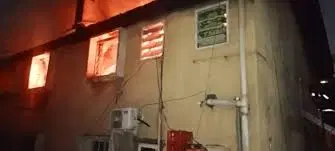
A major fire gutted a one-storey commercial building in the heart of Computer Village, Ikeja, Lagos, in the early hours of Tuesday, January 20, 2026, destroying goods valued at millions of naira and leaving traders counting significant losses in one of Nigeria’s busiest technology markets.
The blaze, reported around 1:55 a.m. on Somoye Osundairo Street, quickly engulfed the upper floor of the structure, which housed numerous dealers in computers, laptops, printers, and accessories.
The Lagos State Emergency Management Agency (LASEMA) activated its emergency response plan upon receiving distress alerts via toll-free lines, deploying the Lagos Response Team (LRT), firefighters, and paramedics to the scene.
According to Dr. Olufemi Oke-Osanyintolu, Permanent Secretary of LASEMA, responders found “active flames and thick smoke” upon arrival, fuelled by the high volume of combustible electronic materials stored inside the building. The fire spread rapidly across the upper floor, completely razing it before it was fully contained.
No fatalities were reported, but one official from the Lagos State Fire and Rescue Service sustained minor injuries during the operation and received first-aid treatment on site from the Lagos State Ambulance Service (LASAMBUS).
Fire crews and emergency personnel worked to prevent the blaze from spreading to neighbouring structures, carrying out risk assessments and implementing safety measures around the building’s perimeter.
LASEMA said the structure’s integrity was partially compromised by the intense heat, necessitating an immediate structural assessment to ensure future safety. Firefighting crews have shifted to damping-down operations to eliminate residual heat and prevent re-ignition.
Traders and residents gathered at the scene on Tuesday morning, visibly distressed as they assessed the extent of their losses.
Many shop owners watched helplessly as years of investment in stock were reduced to ashes, underscoring the vulnerability of retail businesses in high-risk commercial environments with dense storage of flammable goods.
The cause of the fire remains under investigation, with emergency agencies aiming to establish both immediate triggers and any underlying safety lapses. Authorities said the probe will include reviews of electrical systems, storage practices, and compliance with fire safety regulations to prevent similar incidents in the future.
Computer Village, widely recognised as one of Africa’s largest technology markets, hosts hundreds of traders and small business owners who depend on reliable infrastructure and safety measures to protect their livelihoods.
Urban business analysts warn that recurring fires in such commercial zones can have far-reaching economic impacts, discouraging investment, disrupting supply chains, and deepening financial losses for micro and small enterprises.
In response to the latest disaster, stakeholders are urging improved fire prevention protocols, including the installation of smoke detectors, accessible fire extinguishers, regular electrical inspections, and mandatory safety training for traders operating in high-density markets.
Strengthening collective readiness and emergency response capabilities could reduce damage and protect lives and assets in Nigeria’s vibrant urban business hubs.