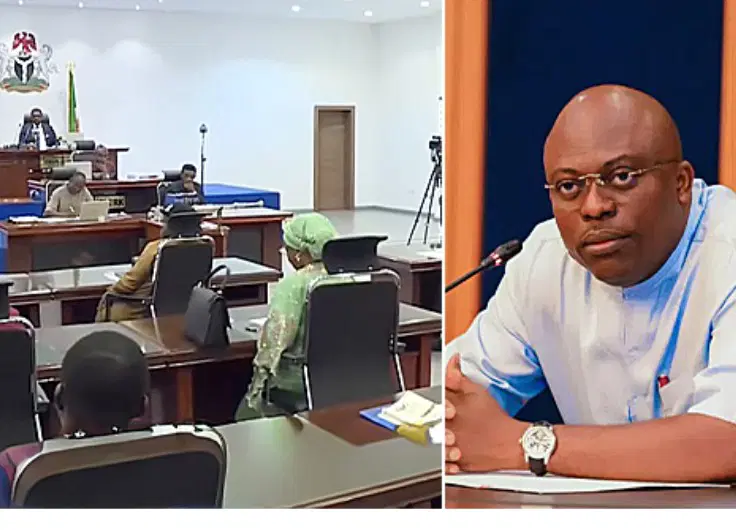
Rivers State lawmakers have accused Governor Siminalayi Fubara of allegedly working behind the scenes to have their constituents recall them from the House of Assembly, rather than engaging in genuine efforts to resolve the lingering political crisis peacefully.
The lawmakers made the allegation during a press briefing in Port Harcourt, saying the governor’s actions undermined efforts at negotiation and constitutional processes.
The political crisis in Rivers State is centred on the attempt to impeach Governor Fubara and his deputy, Prof. Ngozi Nma Odu, over alleged gross misconduct including extra‑budgetary spending exceeding ₦800 billion without legislative approval, withholding statutory funds, demolition of the Assembly complex, and defiance of Supreme Court rulings on legislative autonomy.
The impeachment process began in early January, with the House of Assembly voting overwhelmingly to proceed with investigations.
Relations between the executive and legislative arms have been strained, and while some lawmakers initially sought a negotiated settlement to the crisis, political pressure and distrust have intensified.
Fubara, a leader whose political power base is linked to influential figures in the region, has denied direct involvement in any coercive tactics, although lawmakers insist there is evidence suggesting otherwise.
Speaking at the temporary Assembly complex on Aba Road, Hon. Looloo Opuende of Akuku Toru Constituency 11 alleged that while members were pursuing a diplomatic approach, the governor was secretly funding efforts to have constituents recall lawmakers who backed impeachment.
“While the impeachment process was going on, the governor was busy paying our constituents to withdraw us from the Assembly,” Opuende said, questioning whether such tactics were appropriate in a constitutional democracy.
When journalists sought comment from the governor’s office, Dr. Darlington Oji, Senior Special Assistant on political matters, said simply, “I am not aware” of any such activities.
The lawmakers also addressed allegations surrounding constituency project funds. In previous comments, a government official suggested that each lawmaker received ₦350 million for local projects, but some legislators rejected this figure, stating the funds were not properly appropriated.
The accusation adds a new layer of complexity to the political impasse in Rivers State, where trust between the legislature and the governor’s office has largely broken down. If true, the alleged strategy could fuel perceptions that executive power is being used to influence or undermine democratic institutions, worsening political instability.
For citizens in Rivers, the standoff raises questions about accountability, governance, and the rule of law at the state level. Civil society organisations have already begun litigation and even recall campaigns, indicating that the crisis has mobilised public actors on multiple fronts.
Political analysts say a resolution will likely require sustained constitutional adherence, transparent negotiations, and possibly judicial intervention, given the depth of mistrust between the opposing parties.
The federal government’s role — and mediation efforts — may also shape how the crisis unfolds in the lead‑up to the 2027 general elections.
The allegation by Rivers State lawmakers that Governor Fubara attempted to engineer their recall instead of pursuing peace underscores a volatile political climate.
With impeachment proceedings advancing and both sides maintaining hardline positions, the crisis highlights enduring issues around separation of powers, democratic accountability, and governance dynamics in Nigeria’s subnational politics.
The coming weeks are likely to be pivotal in determining whether the political deadlock will deepen or yield to negotiated compromise and constitutional remedies.