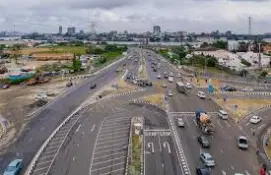
The Lagos State Government has announced that the rescheduled rehabilitation of Sections 2 and 3 of the 20‑kilometre Eti‑Osa/Lekki–Epe Expressway will start on Sunday, January 25, 2026, with an elaborate traffic diversion strategy to guide commuters during the project’s 64‑day duration.
Officials said the phased works are part of efforts to improve safety and road durability on one of the city’s busiest transport corridors.
The announcement followed an inspection tour of the expressway corridor by key government officials, including Mr. Oluwaseun Osiyemi, Lagos State Commissioner for Transportation, Mr. Sola Giwa, Special Adviser on Transportation, and Engr. Olufemi Daramola, Special Adviser on Infrastructure.
Representatives of the Lagos State Traffic Management Authority (LASTMA) and the project contractor were also present during the assessment ahead of the scheduled commencement date.
The rehabilitation will cover the stretch from Admiralty Way Junction to Jubilee Bridge in Ajah (Eti‑Osa Local Government Area).
Work was previously set to begin in December 2025 but was postponed after public concerns about severe traffic congestion prompted Governor Babajide Sanwo‑Olu to suspend plans and shift the project to January 2026 to reduce disruption during the festive period.
Under the newly finalised traffic management plan, the rehabilitation will be carried out in eight sections over 64 days.
The strategy involves phased closures and dynamic lane sharing, rather than shutting down the entire expressway at once. This approach is designed to maintain traffic flow while enabling efficient construction in targeted areas.
Officials said the rehabilitation will begin with the Chevron to Igbo‑Efon section, where work will be done on the Lagos‑bound carriageway.
During this phase, traffic heading toward Lagos will be diverted to the Epe‑bound lane with two lanes available, while one lane will be kept open on the Epe‑bound side. Road shoulders will also be expanded to support the diversion scheme.
Motorists have been advised to plan alternative routes where possible, including connections via the Coastal Road from Ogombo through Abraham Adesanya, and another route linking Coastal Road from Eleganza to Orchid, then through Lafiaji and Naale Street. These alternatives aim to ease pressure on the expressway during peak construction periods.
The government also committed to deploying adequate traffic management personnel, directional signage, proper lighting, and road safety measures throughout the project period to minimise inconvenience for commuters.
Authorities said they are working in collaboration with stakeholders such as the Lekki‑Epe Residents Association to raise awareness and guide road users effectively.
Transport and logistics experts note that structured rehabilitation with clear diversion plans can mitigate traffic snarl‑ups if well communicated and enforced. Urban commuters and businesses that rely on smooth passenger and goods movement stand to benefit from improved infrastructure, even as short‑term disruptions persist.
The Lagos State Government is positioning the Lekki–Epe Expressway project as a strategic investment in urban mobility and economic efficiency.
Officials emphasised long‑term gains, including enhanced road safety, reduced vehicle wear and tear, and more reliable connectivity for commuters and transport operators once the rehabilitation is complete.