
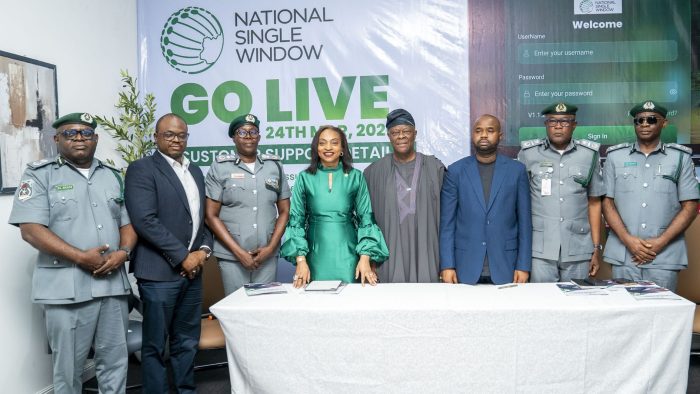
The NSW goes live at DHL Apapa as Nigeria’s National Single Window system has officially begun transmitting cargo manifest data electronically at the DHL Apapa facility.
Earlier technical glitches that disrupted the live demonstration were quickly resolved by the project’s technical team.
With the system now functioning smoothly, the rollout represents a significant step in modernising cargo clearance, reducing delays, and improving transparency in Nigeria’s trade processes.
The National Single Window (NSW) is designed to overhaul Nigeria’s trade facilitation architecture by enabling electronic submission and transmission of cargo manifests and related documentation across regulatory agencies.
Stakeholders hope the system will reduce delays, increase transparency, and improve data uniformity for cargo handling at busy ports like Apapa and Lagos Airport.
The NSW goes live at DHL Apapa launch took place in Apapa and Lagos airport offices, with officials from the Nigeria Customs Service (NCS), Federal Airports Authority of Nigeria (FAAN), and NSW project teams present for the live demonstration.
During the live demonstration at DHL’s Lagos airport office, officials encountered minor glitches that affected manifest transmissions due to a recent password update, resulting in 11 failed upload attempts before successful transmissions.
Davids Malachi, Senior Gateway Manager at DHL, explained that the password update caused temporary delays in transmitting manifest data into the NSW, but noted that the technical team worked swiftly to address the issue.
Despite the initial setbacks, the system began processing manifest submissions successfully, and the first consignment secured a rotation number; a key step that allows further cargo processing and regulatory assessment.
Officials from NCS and FAAN confirmed that additional manifest entries were uploaded in real time with technical support from the NSW team, demonstrating ongoing operations without further interruption.
Tola Fakolade, Director of the NSW Project, said the live demonstration was part of broader efforts to show how logistics operators and regulators can use the platform to enhance cargo clearance, reduce delays, and improve transparency.
Fakolade acknowledged that initial hiccups were expected in a project of this scale, but emphasised that joint technical teams were prepared to resolve issues swiftly, underscoring strong inter‑agency collaboration.
Oluyomi Adebakin, Deputy Comptroller General of ICT and Modernisation at NCS, said the system update briefly disrupted transmission processes but was promptly fixed by technical teams, allowing manifest data to go through.
Officials highlighted that continuous collaboration among the Customs Single Window unit, NSW technical team, and Trade Modernisation Project staff would support smooth operations moving forward.
The NSW goes live at DHL Apapa rollout signals significant progress in digital trade facilitation, particularly for cargo operators and importers who have long grappled with data inconsistencies and bureaucratic delays in clearance processes.
For logistics companies, seamless electronic manifest transmission can shorten cargo dwell time, improve regulatory compliance, and enhance operational efficiency.
Accurate and unified data also supports more informed decision‑making for government agencies and private sector stakeholders, improving planning and potentially boosting national revenue performance.
By reducing inefficiencies and enhancing transparency, the NSW aligns with broader efforts to modernise Nigeria’s ports and trade infrastructure, a priority for economic competitiveness.