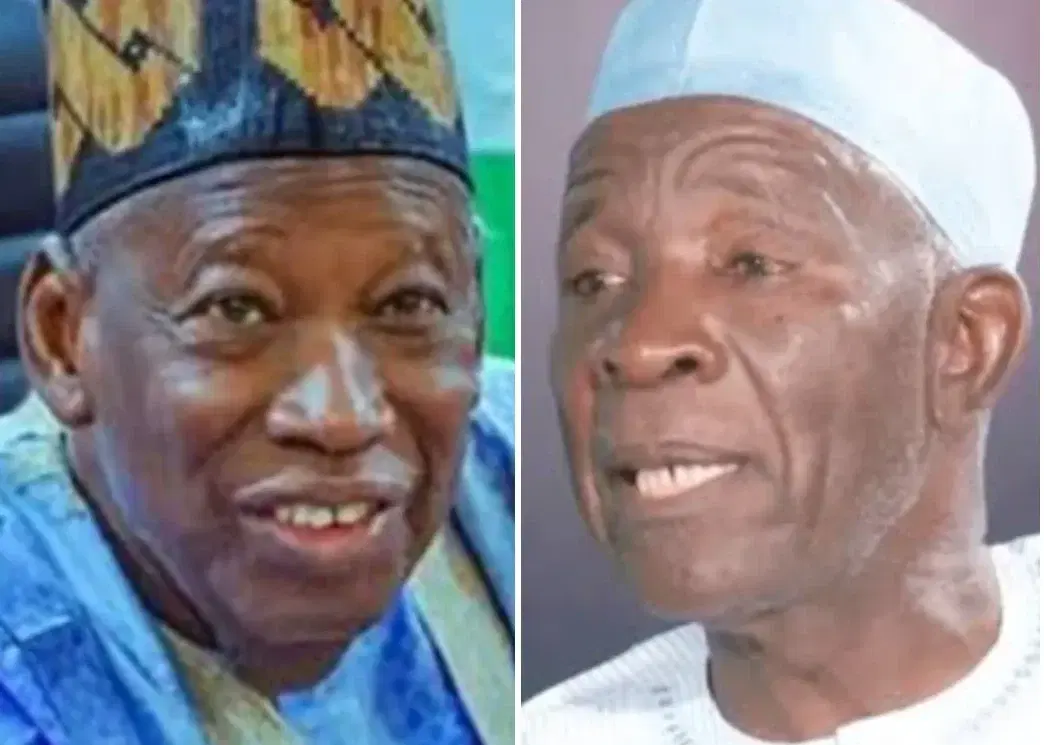
Abuja political tensions escalated on Tuesday, January 27, 2026, as Chief Oliver Okpala, a senior aide to former All Progressives Congress (APC) National Chairman Dr. Abdullahi Umar Ganduje, delivered a sharp response to criticism from New Nigeria Peoples Party (NNPP) chieftain Buba Galadima.
Okpala’s statement labelled Galadima a “television politician with no base,” deepening an already strained public exchange between the two political figures.
The confrontation centres on recent remarks attributed to Galadima alleging that Ganduje disrespected former President Muhammadu Buhari, a claim Okpala has vehemently rejected.
Okpala described the accusations as a “mischievous fabrication,” asserting that Ganduje’s national stature and political record stand in contrast to Galadima’s media-focused reputation.
The dispute reflects broader tensions in Nigeria’s political discourse as parties and their leaders navigate reputational battles ahead of the 2027 general elections.
Okpala, serving as Senior Special Assistant on Public Enlightenment to Ganduje, criticised Galadima’s methods, urging him to focus on substantive political engagement in his home state rather than national media appearances that, according to Okpala, lack grounding in electoral participation or local constituency support.
Ganduje, a two-term former Governor of Kano State and former national chairman of the APC, has been a prominent figure in national politics. Okpala highlighted Ganduje’s record of political service and development work in Kano, characterising it as evidence of tangible leadership achievements.
Chief Okpala’s statement in Abuja directly challenged Galadima’s credibility, asserting that his political influence is concentrated on television rather than within electoral constituencies. Okpala urged the NNPP leader to return to his home state and contribute to local political and economic development.
“Such accusations are laughable when they come from someone who has never contested or won an election in his life,” Okpala said, emphasising Ganduje’s disciplined political conduct and longstanding service.
He described Galadima as a “sadistic personality” whose negative narratives complicate constructive political dialogue in Nigeria.
Okpala also refuted suggestions that Ganduje was “disgraced” or politically weakened, noting that the former governor completed two full terms with a legacy of infrastructural and social development in Kano State. He stressed that criticism rooted in media posturing does not reflect the realities of grassroots political engagement.
The exchange between Okpala and Galadima illustrates the increasing role of media and personal narratives in shaping political reputations across Nigeria’s urban centres.
For urban youth, civic leaders, and political stakeholders, such public disputes offer insight into how political capital and influence are contested beyond traditional party structures.
Analysts note that characterisations like “television politician” may resonate in a media-savvy electorate while also highlighting gaps between public visibility and grassroots political strength.
Engagement strategies that balance media presence with community organisation may prove more effective for political actors seeking lasting influence.
The clash between Ganduje’s aide and Buba Galadima underscores a broader contest over political legitimacy and influence in Nigeria’s evolving democratic landscape.
As parties and their supporters prepare for the 2027 elections, responses to criticism and efforts to define political identities will continue to shape public perceptions and engagement across urban Nigeria.