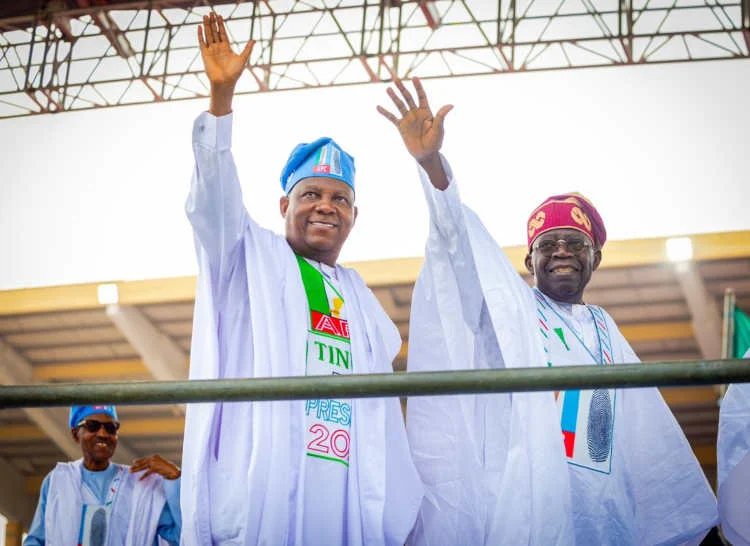
President Bola Tinubu and Vice President Kashim Shettima are set to spend N9,364,349,417 on official travels and food-related expenses in the 2026 fiscal year, according to the details of the 2026 Appropriation Bill released by the Budget Office of the Federation.
This allocation covers local and foreign trips, meals, catering supplies, and related expenditures and has drawn public attention amid competing budget priorities. The budget figures highlight ongoing discourse on government expenditure amid Nigeria’s broader economic challenges.
Nigeria’s 2026 budget estimate, totalling N58.18 trillion, was presented to a joint session of the National Assembly on December 19, 2025, with national security and economic stability cited as core priorities. In the budget document, significant funds were also earmarked for defence (N3.2 trillion), power (N1.1 trillion), education (N2.3 trillion), and health and social welfare (N2.1 trillion). Agriculture and food security received N1.4 trillion, and the Independent National Electoral Commission was allocated N1 trillion.
Budget allocations for official travel and related expenses have been part of Nigeria’s appropriation practices, though the scale often prompts public scrutiny when set against living costs and development needs in urban centres. The proposed spending follows broad debates on fiscal responsibility and government accountability in public budgeting.
Details from the budget proposal show that President Tinubu is forecast to spend N7,014,596,511 on local and international travels, with N431,620,183 allocated for foodstuffs, catering materials, supplies, refreshments, and meals. The foreign component of his travel budget stands at N6,140,709,822, while domestic travels are assigned N873,886,689.
Vice President Shettima’s allocation includes N1,732,106,437 for both local and overseas travel and N186,026,286 for food and related supplies. Of that travel allocation, N1,314,618,239 is provided for foreign engagements and N417,488,198 for domestic movements.
The budget document also outlines other executive-related expenditures, including N65.77 million for honorarium and sitting allowances, N895 million for library books and equipment, N179 million for vehicles, and N778.6 million for office furniture and fittings. An allocation of N89.504 million was also earmarked for purchasing sport utility vehicles for the President and Vice President.
For urban citizens, the sizeable expenditure on official travel and food raises questions about public spending priorities, especially against the backdrop of inflationary pressures and low household incomes in major Nigerian cities. Allocations of this magnitude on non-development expenditures could intensify calls for budget realignment toward social services and infrastructure that directly affect urban livelihoods.
Small and medium enterprises in urban Nigeria, which are grappling with higher operating costs and reduced consumer demand, may see limited trickle-down benefits from such allocations. Public discourse may shift further toward transparency mechanisms and the value derived from diplomatic and domestic travel relative to economic returns. Policymakers and civil society could use this budgetary data to advocate for clearer justifications and measurable outcomes tied to travel-related spending.
The allocation of N9.36bn for the President’s and Vice President’s travel and food expenses in the 2026 budget spotlights enduring debates on fiscal priorities within Nigeria’s governance framework. Urban stakeholders, including business owners and workers, may scrutinise such expenditures more closely amid ongoing economic recovery efforts.
Enhanced transparency and accountability in budget implementation could strengthen public trust and ensure that government spending aligns more closely with urban development needs and sustainable economic growth.