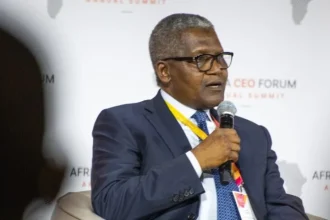

Former Minister of Sports, Barr. Solomon Dalung, has accused the Federal Government of lacking political will in addressing worsening insecurity across the country, alleging that the administration of President Bola Tinubu is more focused on the 2027 elections than on protecting lives. Dalung made the claim during an appearance on Arise Television’s Morning Show, where he criticised the government’s response to terrorism and abductions. He said the state lacks political will to effectively confront armed groups responsible for attacks nationwide.
Dalung’s remarks come amid continued national concern over terrorism, banditry, and school kidnappings affecting several regions of Nigeria. The discussion also reflects ongoing political tension as attention gradually shifts toward the 2027 general elections.
The former minister, who served under the administration of former President Muhammadu Buhari, delivered a wide-ranging critique of the current government’s handling of security, governance, and economic reforms.
He argued that weak coordination among security agencies and poor strategic alignment have contributed to Nigeria’s inability to curb violent attacks.
Dalung said the government has failed to demonstrate adequate commitment in confronting terrorism, insisting that security capabilities are being misapplied.
“Government seems not to have the political will to deal with it. They have all the gadgets to track anybody who criticises the government — they can pick him up in the next five minutes. But they don’t have equipment to track terrorists who display huge phones in the forest, behead teachers, abduct schoolchildren, torture them in the forest, produce videos and send,” he said.
He further described the government’s appeal for national unity against terrorism as inappropriate, arguing that it reflects systemic failure.
“I think it’s a statement confirming that the federal government has completely and woefully failed. They don’t seem to have any idea of a solution to the ravaging insecurity that is across the country,” Dalung said.
The former minister also criticised what he described as fragmented operations within the country’s security architecture, stating that intelligence and military agencies operate independently rather than in coordination.
According to him, this lack of synergy has allowed insurgent groups to strengthen their operations and sustain illicit activities in remote areas. Dalung further questioned the effectiveness of foreign security partnerships, including reported American military involvement.
“We were told that the Americans are here with us. If the Americans are here with us, what have they been doing? We have not felt their impact,” he said.
He called for greater reliance on community-based security structures and stronger local engagement in addressing insecurity.
Dalung also warned that Nigeria’s political environment ahead of 2027 could heighten instability, citing increasing political fragmentation across geopolitical zones. He added that the country’s economic reforms have not translated into tangible benefits for citizens, describing the situation as worsening hardship.
“Three years into his tenure, it is just blame game and rhetorics of reforms — reforms that no single iota of the benefit has trickled down. Rather, Nigerians are getting impoverished daily. The economy is in doldrums. Insecurity remains rhetorical,” he said.
However, political analyst Obafemi George offered a different perspective, arguing that the administration should be assessed within the context of inherited structural challenges.
He cited the upgrade of Nigeria’s sovereign credit rating by Standard and Poor’s from B- to B as evidence of macroeconomic improvement. George attributed rising insecurity partly to regional instability, including the withdrawal of French military forces from the Sahel region, which he said created security vacuums exploited by terrorist groups.
“This current administration has confronted insecurity that is higher than the previous administration, spent more, and recorded more successes in combating insecurity,” he said. He also referenced military operations in Goza and Katsina, describing them as examples of ongoing counter-terrorism efforts and rescue missions.
George argued that national development requires long-term planning, stating that historical reforms in countries such as China and the United Arab Emirates took decades to materialise. He maintained that while Nigerians are experiencing economic hardship, structural reforms are intended to yield long-term benefits.
The debate over whether the government lacks political will highlights deep divisions in public assessment of Nigeria’s security and economic direction. Critics point to persistent attacks and kidnappings as evidence of failure, while supporters argue that ongoing reforms and security operations are beginning to show progress.
The discourse also underscores growing pressure on security institutions to improve coordination and deliver measurable results in combating terrorism.