
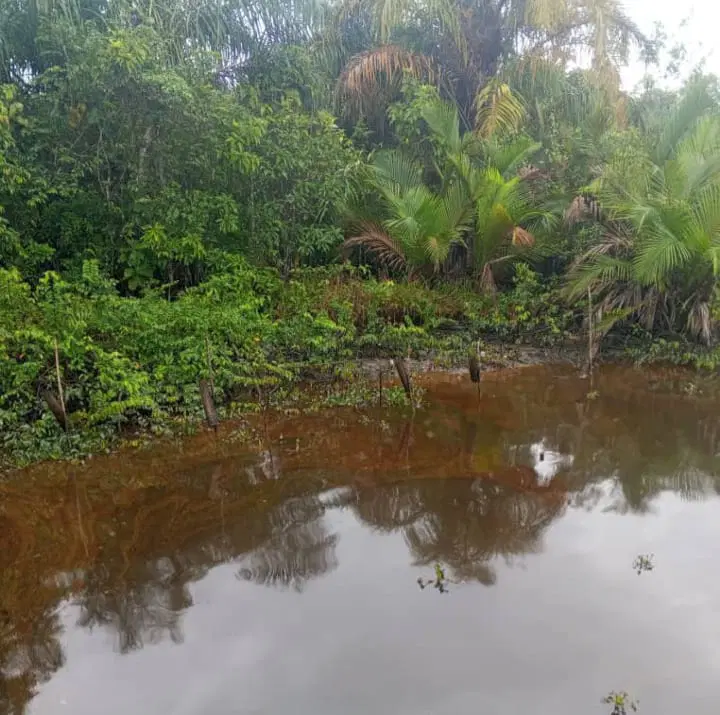
Fresh uncertainty surrounds the recent Bayelsa oil spill in Azuzuama community, Southern Ijaw Local Government Area, as residents continue to assess the environmental damage while disagreeing with investigators over the cause of the pipeline failure.
The spill, first reported on June 25, 2026, occurred on the 6-inch Azuzuama/Tebidaba flow line, sending crude oil into the surrounding environment and reopening painful memories of a tragedy that claimed 14 lives more than a decade ago.
For many residents, the latest incident has revived memories of the July 9, 2015 pipeline explosion that killed 14 people, including community members, government officials and oil workers during a Joint Investigation Visit and repair operation. One resident, identified simply as Ebi, said the community has never fully recovered from the disaster.
“We cannot forget July 9, 2015. That day, 14 people, some from our community, government officials and oil workers, died during a Joint Investigation Visit and repairs. The scar remains,” he said.
Now, years later, the community finds itself once again confronting concerns over ageing oil infrastructure, this time involving facilities inherited by Oando from the former Nigeria Agip Oil Company Limited (NAOC).
The latest investigation has reportedly ended without a unanimous conclusion after disagreements emerged between regulators and community representatives over what caused the pipeline failure.
According to the Environmental Conservation Agriculture and Rural Development (ECARD), the Joint Investigation Visit failed to produce a conclusive outcome because the parties could not agree on the source of the leak. Representing the Bayelsa State Ministry of Environment, the Director of Petroleum Pollution, Engr. Reuben Enai, maintained that preliminary visual assessments pointed to induced corrosion rather than natural deterioration.
He said investigators observed burn marks on the protective coating of the pipeline, suggesting that acid may have been deliberately applied to weaken the metal. According to Enai, the location of the damage on the upper section of the pipeline was inconsistent with ordinary corrosion.
Leaders of the Azuzuama community have, however, rejected the conclusion, insisting that the spill resulted from ageing infrastructure and prolonged corrosion rather than deliberate sabotage. Chairman of the Azuzuama Community Development Committee, Mr. Angasei Perediseghebofa, argued that visible rust on the exposed pipeline clearly indicated years of deterioration.
He also questioned the credibility of the investigation, alleging that testing equipment introduced during the exercise malfunctioned, making it impossible to accurately determine the true cause of the spill. The community’s Vice Chairman, Mr. Uyabara Boneghen, also expressed doubts about the reliability of the testing devices, claiming they produced identical readings at different points during the inspection.
As uncertainty continues over the cause of the spill, residents say their priority remains addressing the environmental damage and ensuring accountability.
The disagreement over whether the incident resulted from sabotage or equipment failure is expected to play a significant role in determining responsibility for remediation, compensation and future maintenance of the pipeline network serving the area. For the people of Azuzuama, however, the incident represents more than another oil spill, it is another painful reminder of unresolved environmental concerns and a community still living with the scars of past tragedies.