
Minister of Aviation and Aerospace Development, Festus Keyamo, has revealed how Abia State Governor Alex Otti successfully convinced President Bola Tinubu to support the transformation of a proposed federal airstrip into a full-scale Abia international airport.
The minister disclosed that the Federal Government initially planned to construct a basic airstrip in the state as part of efforts to improve aviation infrastructure across the South-East. However, Otti pushed for a more ambitious project that would position Abia as a major aviation and economic hub. Keyamo made the revelation during the unveiling ceremony of two Boeing 737-800NG aircraft recently acquired by United Nigeria Airlines in Lagos.
According to the minister, the idea of providing aviation infrastructure in Abia State originated shortly after the current administration assumed office. He explained that he had informed President Tinubu that Abia was the only state in the South-East without either an airport or an airstrip, prompting the Federal Government to include an airstrip project in the 2024 budget.
“When we came to power, I went to Mr President saying Abia does not have an airstrip or an airport in the whole of the South-East. So, he told me to put it in the budget. In the 2024 budget, we put the Abia airstrip as one of our first projects,” Keyamo said.
Rather than settling for the planned airstrip, Governor Otti reportedly approached President Tinubu with a proposal to upgrade the project into an Abia international airport through a counterpart funding arrangement between the state and federal governments.
Keyamo praised the governor’s initiative, noting that the proposal demonstrated a broader vision for economic development and regional connectivity. According to the minister, Otti urged the President to redirect the planned federal funding toward a larger airport project while the state government contributed additional resources to make the vision a reality.
“Credit to Dr Alex Otti, who did not stop at that. He went straight to Mr President and said, ‘Sir, bring the money for the airstrip, I have counterpart funding. I will now make it a full international airport.'” The minister disclosed that construction activities have already commenced under the governor’s supervision.
Keyamo further revealed that the Abia State Government has committed substantial resources to the project. According to him, the state’s financial contribution has already exceeded that of the Federal Government, underscoring its commitment to delivering the Abia international airport project.
“He said, ‘Don’t give me an airstrip, but bring the money. With counterpart funding, I will build a full-fledged international airport in Umuahia, Abia State.’ That project has taken off under his guidance. In fact, Abia has brought more money than the federal government,” Keyamo stated.
The minister also disclosed plans to strengthen economic activities in the South-East through international cargo operations.
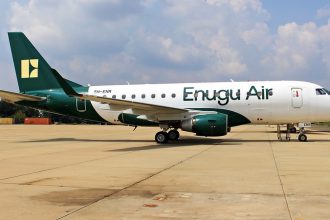
According to him, discussions are currently underway to establish a direct cargo route between Guangzhou, China, and the Akanu Ibiam International Airport in Enugu. Keyamo explained that the initiative is being pursued in collaboration with the Enugu State Government and is expected to support thousands of traders who import goods from China.
“They want to make Enugu Airport a cargo hub for the whole of the South-East,” he said.
The proposed cargo service would allow traders to consolidate shipments in Guangzhou and transport them directly to Enugu without passing through multiple international transit points.
The minister said negotiations are progressing toward launching the first direct Guangzhou-to-Enugu cargo flight by December. If implemented, the route is expected to reduce logistics costs, improve import efficiency and strengthen commercial activities across major South-East trading centres, including Aba and Onitsha.
The developments surrounding Abia international airport and the proposed China-Enugu cargo connection highlight ongoing efforts to expand aviation infrastructure, stimulate regional commerce and improve economic opportunities across the South-East.