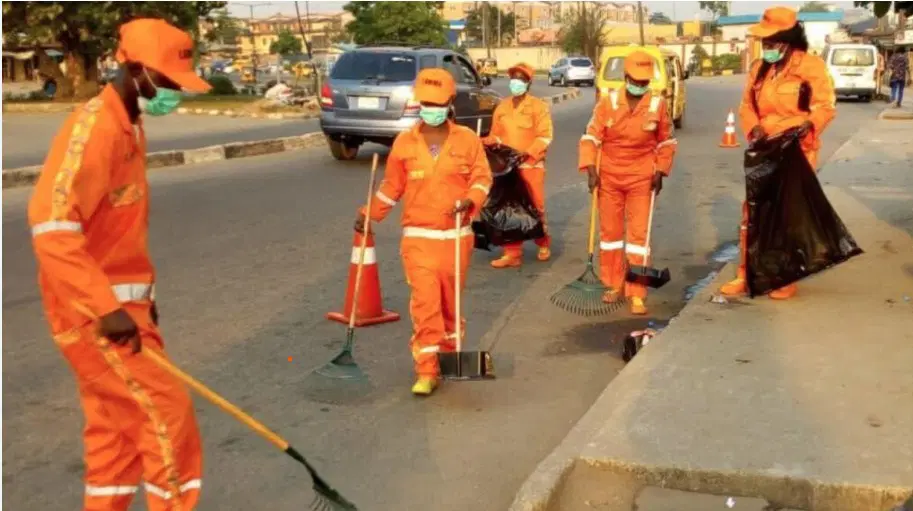
The Lagos Waste Management Authority (LAWMA) has assured residents that ongoing Lagos waste collection challenges will significantly improve within the next six to eight months as the state government expands waste management infrastructure and deploys additional collection equipment. The assurance was given by LAWMA Managing Director, Dr. Muyiwa Gbadegesin, during the monthly environmental sanitation exercise held in Badagry on Saturday.
Gbadegesin dismissed reports suggesting that local government councils were taking over LAWMA’s waste management responsibilities through independent refuse collection initiatives.
He clarified that the councils remain partners in the state’s sanitation drive and are working alongside the agency to strengthen waste management services. According to him, each local government is procuring two compactor trucks, while the Lagos State Government is also purchasing additional waste collection vehicles to boost operational capacity across the state.
The LAWMA boss attributed recent collection delays to Lagos’ rapidly growing population and the corresponding increase in the volume of waste generated daily.
He said the state government has already begun expanding its waste disposal infrastructure to meet rising demand. According to Gbadegesin, construction work is ongoing at the Olusosun facility, while new transfer loading stations and material recovery facilities are being developed in strategic locations.
He disclosed that Badagry will also host a major material recovery facility designed to support recycling and resource recovery rather than serving as a traditional dumpsite. Gbadegesin explained that the facility would enable safer waste treatment while recovering recyclable materials capable of generating additional revenue.
The LAWMA Managing Director revealed that recent heavy rainfall around the Olusosun dumpsite temporarily disrupted refuse evacuation after flooding made access roads difficult for waste trucks.
However, he expressed optimism that the situation would improve with the reopening of an alternative dumping section expected to restore smoother operations. He noted that only about 30 to 40 percent of Private Sector Participant (PSP) operators experienced operational challenges during the disruption.
According to him, many operators have continued to dispose of waste at alternative satellite facilities located in Epe, Ikorodu and Badagry. Gbadegesin said residents should begin noticing improvements in waste collection before the end of the week.
While expressing confidence in ongoing improvements, Gbadegesin appealed to residents to properly store household waste and promptly pay PSP operators to support efficient refuse collection.
He described waste management as a shared responsibility and urged residents to avoid dumping refuse along roadsides whenever collection is delayed. He also encouraged members of the public to report service failures through LAWMA’s customer service channels to enable swift intervention.
Speaking during the sanitation exercise, the Lagos APC deputy governorship candidate, Princess Damilola James, encouraged residents to embrace routine environmental sanitation, especially during the rainy season.
She noted that keeping drains free of debris helps reduce flooding and improves public health. James called on residents to support the Lagos State Government’s sanitation enforcement efforts and maintain cleanliness beyond the monthly sanitation exercise.
According to her, community sanitation initiatives promote unity, strengthen neighbourhood relationships and encourage shared responsibility for environmental development. She also commended environmental authorities for enforcing sanitation regulations across the state and expressed confidence that Lagos would continue improving its environmental cleanliness in the coming years.
LAWMA maintained that ongoing investments in infrastructure, recycling facilities and additional collection vehicles will significantly enhance Lagos waste collection and improve service delivery across the state within the projected six to eight months.