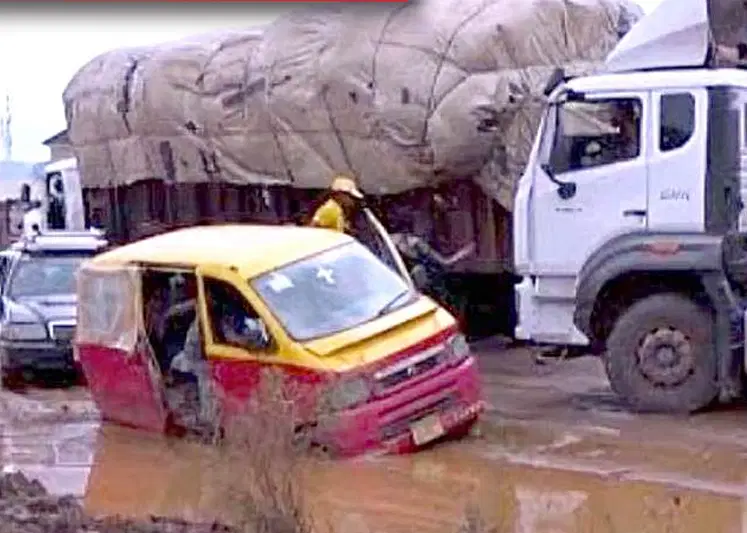
Motorists and passengers travelling along the Benin-Asaba road are facing severe hardship as failed sections of the highway continue to cause prolonged gridlock and lengthy travel times.
The worsening condition has left some motorists stranded for several days, with travellers reportedly spending nights inside vehicles as they struggle to navigate the corridor.
The development has prompted the Federal Government to announce plans to review concessioned roads across the country to determine whether concessionaires are complying with the terms of their agreements.
The Minister of Works, Engr. David Umahi, disclosed this during an inspection of the concessioned Benin-Asaba highway.
Umahi criticised the concessionaire, BAECC, accusing the company of poor handling of the project and saying it lacked the technical capacity required for the work.
He said the government would convene a meeting involving relevant stakeholders to review the situation.
The minister also promised that the government would deploy a contractor to carry out immediate work aimed at making the highway motorable.
The Benin-Asaba highway was concessioned to BAECC in 2025 for reconstruction into a 10-lane highway.
The project was scheduled for completion, alongside the installation of toll gates, by September 2027. The concession arrangement was expected to allow the company to recover its investment while maintaining the road for 25 years.
However, Umahi said the concessionaire worsened the condition of the existing road by removing asphalt despite warnings from the Ministry of Works.
He said such action amounted to the destruction of public property.
“Ministry of Works does not allow removal of asphalt. We begged them not to remove it.”
Umahi said he had directed the ministry to take action against concessionaires who removed asphalt from existing roads.
He also accused the company of manipulating the process through which it secured the project.
While commending Edo State Governor Monday Okpebholo for intervening on several federal roads in the state, the minister apologised to commuters affected by the deteriorating highway.
He said the Niger Delta Development Commission, NDDC, was also willing to intervene.
The Chief Executive Officer of BAECC, Mr Samuel Daramola, attributed the slow pace of construction partly to heavy rainfall and the volume of traffic using the highway.
Daramola said the company had expanded sections of the road to eight lanes and carried out palliative works.
He explained that the heavy traffic made it difficult to construct side drains without repeatedly reopening sections of the road to motorists.
According to him, the company had sometimes been forced to open roads before completed sections had fully cured.
He said BAECC remained committed to completing the project despite the challenges.
The project’s consultant, Engr. Toyin Akinlapa, however, said the concessionaire failed to follow technical instructions.
Akinlapa said the company had been advised to construct drainage systems before proceeding with other aspects of the work.
The deteriorating Benin-Asaba road has severely affected passengers and commercial drivers.
A female passenger travelling with her two-year-old son told Vanguard that she had spent nights inside a bus at Agbor because she could not afford hotel accommodation.
She said she was travelling to Imo State for a ceremony but became trapped by the gridlock.
A truck driver also described the situation as frustrating, noting that a journey from Lagos to Benin that ordinarily takes about four hours could now take several additional days once motorists reach the affected sections.
He warned that prolonged delays were putting vehicles and goods at risk, particularly consignments carrying perishable products.
Another logistics driver said he spent three days transporting raw materials from Lagos to Asaba.
He said he left Lagos on August 20 and arrived in Asaba on August 23 after spending one day around the Benin bypass and two days and two nights in Agbor.
Residents and community leaders said the poor condition of the highway was also hurting economic activity.
A Benin resident said several businesses had shut down because the road serves as an important route linking the area with Abuja, Delta State and the South-East.
Chairman of the Ikpoba Hill Youth Forum, Kingsley Osemwingie, said residents had previously protested over the condition of the road.
He urged the Federal Government to intervene and replace the concessionaire if it was unable to deliver the project.
A cleric, Rev. Philip Aroje, who said he had lived in the area for about 30 years, also accused the concessionaire of failing to deliver the expected improvement.
He recalled that residents initially expected relief when construction activity began but said the work had not translated into a usable highway.
The condition of the highway has also renewed concerns over infrastructure across the South-South region.
The National Chairman of the Pan Niger Delta Forum, PANDEF, Ambassador Godknows Igali, described the situation as a crisis and accused the Federal Government of neglecting the region’s infrastructure.
Igali argued that the region, which contributes significantly to Nigeria’s economy, deserved greater attention to its transportation infrastructure.
He said several major routes connecting the South-South with other parts of the country were also in poor condition.
According to him, motorists travelling from Benin towards Auchi and Okene face serious challenges, while other routes towards Akure are similarly affected.
He said the deteriorating roads were creating frustration and resentment among residents.
The Chairman of the House Committee on Works, Akin Alabi, called on President Bola Tinubu to review agreements with road concessionaires.
Alabi said concession arrangements should not leave Nigerians bearing the consequences of poorly executed projects.
He urged the government to introduce immediate palliative measures to restore movement while longer-term reconstruction continues.
The worsening condition of the Benin-Asaba corridor comes ahead of the festive period, when traffic and the movement of passengers and goods are expected to increase.
With motorists already spending days on the route, pressure is mounting on the Federal Government to provide an immediate solution while reviewing the concession arrangement and the contractor’s performance.