By Ureh Ogbonna
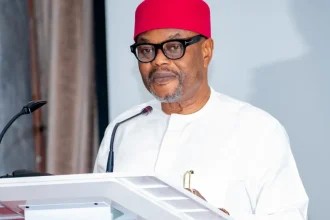
As the 2027 governorship election approaches, one political reality is becoming increasingly difficult to ignore: Chief Uche Geoffrey Nnaji—Nwakaibie—has a credible path to victory in Enugu State.
Elections are never won in advance. But judged by his platform, experience, message and emerging political coalition, Nnaji is far more than an ordinary opposition candidate.
Governor Peter Mbah’s defection from the Peoples Democratic Party to the All Progressives Congress has redrawn Enugu’s political map. It left behind a PDP identity and grassroots network built over more than two decades.
Nnaji now has the opportunity to rebuild that traditional PDP base while retaining relationships formed during his years in the APC. This gives him access to political forces on both sides of the old divide.
THE 2023 RESULT PROVES ENUGU IS OPEN
The 2023 governorship election showed that no party can take Enugu voters for granted.
Mbah won with 160,895 votes, while Labour Party’s Chijioke Edeoga received 157,552—a difference of only 3,343 votes.
That narrow margin reveals an independent-minded electorate willing to change political direction. Nnaji is also entering the 2027 contest from a much stronger position. He is now the candidate of the PDP—the party that governed the state continuously from 1999 until Mbah’s defection.
In 2027, he can combine his personal following with the PDP’s grassroots structure, dissatisfied political interests and voters seeking a credible alternative.
A 4-YEAR COVENANT BACKED BY PERSONAL SACRIFICE
Perhaps Nnaji’s most powerful political asset is his public commitment to serve for only one four-year term. Unlike many political promises, his covenant is supported by a remarkable precedent.
In the 1999 general election, Nnaji won the Enugu East senatorial seat by a landslide, reportedly carrying 65 of the district’s 66 wards. Yet, before he could be sworn in, he voluntarily relinquished the mandate to allow Chief Jim Nwobodo to emerge as senator, at a time when Nwobodo was being considered for the Senate presidency.
Nnaji surrendered a mandate he had already won without demanding another position in return. Contemporary accounts confirm that his withdrawal created the vacancy through which Nwobodo was subsequently returned unopposed.
He has been described as the first senator-elect in Nigeria’s political history to win an election and voluntarily decline to be sworn in.
That sacrifice gives unusual credibility to his present covenant. A man who once surrendered a Senate seat after winning a landslide victory can reasonably ask the people to believe him when he promises to leave office after one term.
The covenant also respects Enugu’s zoning arrangement. Nnaji is seeking one term to complete the tenure of Enugu East and hand over in 2031 to Enugu West—the next zone in the rotation.
“One Term. One Mission. One Legacy” is therefore more than a campaign slogan. It reflects a political history in which Nwakaibie has already demonstrated that he can put collective interest above personal power.
A MESSAGE BUILT AROUND JOBS
Nnaji’s industrialisation agenda gives his campaign a clear identity.
Enugu has thousands of educated young people, artisans, traders and graduates searching for meaningful opportunities. Many are leaving the state and the country because they cannot find adequate employment at home.
Industrialisation speaks directly to that reality. It shifts the conversation towards factories, jobs, skills, technology, agriculture and local production.
Nnaji has spent much of his professional life in business and industry. He also served as Nigeria’s Minister of Innovation, Science and Technology. This allows him to present himself as someone who understands both private enterprise and the workings of government.
His proposition is straightforward: Enugu cannot prosper merely by taxing existing businesses and sharing government revenue. It must create new industries, support entrepreneurs and transform its educated population into a productive economic force.
EXPERIENCE AND GRASSROOTS CONNECTIONS
Nnaji’s political journey did not begin in 2023. He has participated in Enugu politics since the return of democracy and has built relationships across generations, parties and local government areas.
He understands that elections are not won through billboards and rallies alone. They are won inside wards, communities, markets, churches, families and polling units.
His emerging grassroots structure could become decisive if properly sustained. The 2027 election may be won by the candidate with the most organised polling-unit network—not necessarily the one who stages the biggest political ceremonies.
THE PDP STILL HAS DEEP ROOTS
Governor Mbah’s defection gave the APC control of the state government, but it did not automatically transfer every PDP member and voter to the APC.
For more than two decades, the PDP became part of Enugu’s political identity. Thousands built their political careers and community networks within the party. Many may welcome an opportunity to revive it under a candidate capable of funding and leading a serious campaign.
If Nnaji can reunite the old PDP family, retain his former political allies and attract undecided voters, the electoral arithmetic could change dramatically in his favour.
A BROAD COALITION FOR VICTORY
Nnaji’s strongest path to Lion Building lies in building a coalition larger than the PDP.
That coalition could include traditional PDP supporters, former APC allies, young voters, traders, professionals, rural communities and citizens who believe that Enugu needs stronger political competition.
He does not need every voter dissatisfied with the present government. He only needs to become the most acceptable meeting point for the different groups seeking an alternative.
His victory is not guaranteed, but his chances are real and capable of growing. He has a recognised platform, extensive political experience, federal exposure, a one-term commitment and an economic message centred on jobs and production.
If Nwakaibie can unite his party, organise across the 260 wards and convince the people that his covenant is sincere and achievable, the road to Lion Building will not merely be hopeful.
It will be entirely possible.