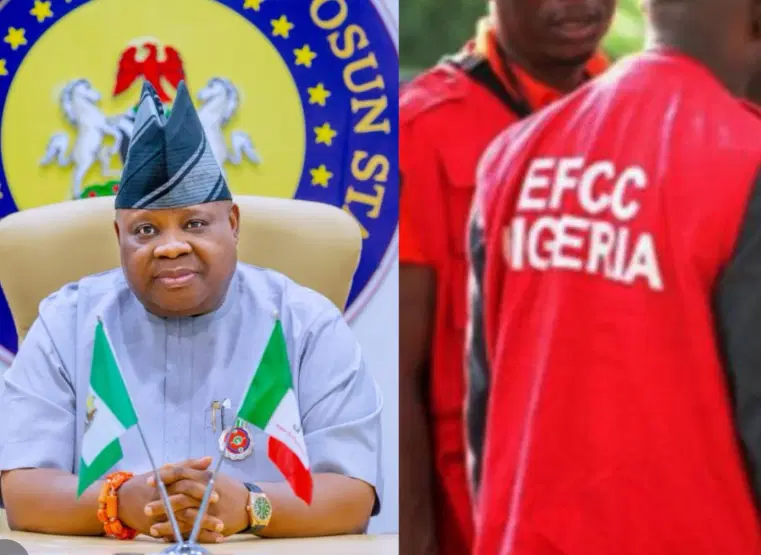
The freezing of an Osun State Government bank account by the Economic and Financial Crimes Commission (EFCC) has triggered a wave of political backlash and legal debate, with Governor Ademola Adeleke, opposition parties and senior lawyers questioning the legality and timing of the action just days before the state’s governorship election.
While the Osun Government described the move as unconstitutional and politically motivated, the EFCC insisted it acted to prevent the alleged diversion of public funds during an ongoing financial investigation.
Governor Ademola Adeleke confirmed that he has directed the state’s Attorney-General and Commissioner for Justice to challenge the EFCC’s action at the Federal High Court in Osogbo. Addressing journalists in Osogbo, the governor described the freezing of the state’s account as an abuse of the rule of law and demanded that EFCC Chairman Ola Olukoyede publicly justify the decision.
According to Adeleke, the commission must explain why such a drastic action was taken against the state government and provide evidence supporting its position. He argued that actions capable of disrupting governance undermine Nigeria’s democratic system and vowed to seek judicial redress.
Osun State Attorney-General and Commissioner for Justice, Oluwole Jimi-Bada (SAN), maintained that the anti-graft agency lacks the constitutional authority to freeze a state’s statutory account.
He argued that the account contains funds designated for salaries, pensions, healthcare, education, security and other essential public services, stressing that any restriction on such funds raises constitutional questions that should only be determined by a competent court.
Jimi-Bada said the state government remains committed to transparency and lawful investigations but insisted that investigative agencies must operate strictly within constitutional limits.
Responding to the criticism, the EFCC said the decision followed investigations into the alleged mismanagement of approximately ₦11 billion in Ecology Funds, Intervention Funds and allocations from the Federation Account Allocation Committee (FAAC).
According to the commission, investigations began in March 2026, with several government officials, including the state’s Accountant-General, already questioned by investigators.
The EFCC stated that it only imposed the post-no-debit restriction after detecting what it described as suspicious transfers of large sums of money from the government account into multiple corporate entities beginning on August 2, 2026.
The agency maintained that freezing the account was a preventive measure aimed at safeguarding public funds and denied allegations that the action was connected to the forthcoming governorship election. It also disclosed that similar financial investigations are ongoing in several other states.
The development has drawn strong reactions from opposition political parties. The Accord Party accused the EFCC of attempting to influence the August 15 governorship election in favour of the All Progressives Congress (APC), describing the action as unconstitutional and promising to challenge it in court.
Similarly, the African Democratic Congress (ADC) alleged that the freezing of public funds forms part of a broader political strategy to weaken the Osun State Government before the election. The party argued that withholding resources meant for governance ultimately affects ordinary citizens through delayed salaries and disruptions to public services.
Several legal practitioners also criticised the development, urging strict adherence to due process. Senior Advocate of Nigeria, Kunle Edun, described the timing of the account freeze as troubling, warning that restricting a state’s operational account could effectively cripple government activities.
Other lawyers, including Chukwuma Omezie, Evans Ufeli, Abdullahi Musa and Bartholomew Ojonugwa, stressed that although the EFCC possesses investigative powers, any decision to freeze accounts should be backed by valid court orders and exercised without creating the perception of political interference.
They cautioned that actions affecting government operations close to an election risk undermining public confidence in democratic institutions.
Meanwhile, the Osun APC urged the EFCC and the Independent Corrupt Practices and Other Related Offences Commission (ICPC) to investigate what it described as the alleged use of state funds for vote buying.
The party claimed that thousands of residents and workers had received ₦20,000 payments ahead of the governorship election. Responding to the allegation, the Osun State Government dismissed the claims, explaining that the payments formed part of its ongoing palliative programme for civil servants aimed at cushioning economic hardship.
Government spokesperson Olawale Rasheed said the administration introduced periodic palliative payments long before implementing the new minimum wage and insisted the initiative had no political motive. As legal proceedings begin, the dispute is expected to remain one of the dominant issues ahead of Osun State’s governorship election.