
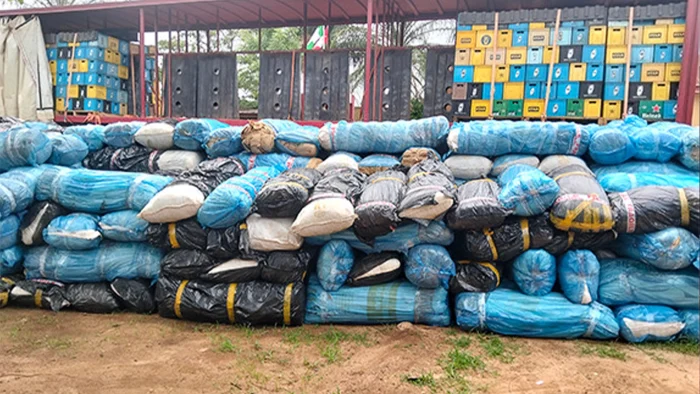
NDLEA drug interception has resulted in a major breakthrough in Edo State following the seizure of two trucks carrying 7,245 kilograms of cannabis along a major highway corridor. The National Drug Law Enforcement Agency confirmed that five suspects were arrested during the operation.
The illicit consignment was concealed within commercial transport vehicles reportedly moving under the guise of legitimate cargo. The interception highlights intensified enforcement efforts against large-scale drug trafficking networks.
NDLEA drug interception operations have increasingly focused on disrupting organised trafficking routes that connect southern production zones with northern distribution markets. Edo State remains a critical transit corridor due to its road network linking multiple regions of the country.
Over time, traffickers have adapted by using commercial trucks and mixed cargo disguises to avoid detection. This method allows large quantities of illicit substances to move across state boundaries with reduced suspicion.
The National Drug Law Enforcement Agency has responded by strengthening intelligence-led surveillance along highways and border-adjacent routes. These operations are aimed at identifying not only couriers but also logistics networks behind drug movement.
NDLEA drug interception in Edo was carried out after a coordinated surveillance operation along the Auchi–Abuja expressway axis. Operatives tracked two trucks suspected of transporting concealed contraband before moving in for inspection.
A detailed search of the vehicles revealed 483 bags of processed cannabis hidden beneath other cargo materials. The total weight of the seized substance was confirmed at 7,245 kilograms.
One truck contained 260 bags weighing 3,900 kilograms, while the second carried 223 bags weighing 3,345 kilograms. The vehicles were reportedly registered in Oyo State and were intercepted while heading toward Abuja.
Five individuals were arrested in connection with the shipment. Preliminary reports indicated that the consignment originated from a production point in Edo State before being routed through interstate transport channels.
NDLEA officials confirmed that the interception followed sustained intelligence gathering and field surveillance. The agency also stated that investigations are ongoing to identify wider networks connected to the shipment and to trace financial and logistical links supporting the operation.
NDLEA drug interception in Edo underscores the scale and organisation of drug trafficking operations within commercial transport systems. The use of heavy-duty trucks reflects coordinated logistics structures rather than isolated smuggling activity.
For enforcement agencies, the operation reinforces the importance of intelligence-driven monitoring of highways and transport hubs. Sustained surveillance is essential to detect concealed cargo movements across states.
For transport and logistics sectors, the case highlights the need for stricter cargo verification procedures and improved compliance checks. Strengthening oversight mechanisms can reduce exploitation of legitimate transport systems.
For communities, such interceptions help limit the circulation of illicit substances linked to crime and addiction. However, continuous enforcement remains necessary to prevent reactivation of disrupted routes.
For policymakers, the incident emphasizes the importance of inter-agency collaboration and data-driven enforcement strategies in addressing narcotics trafficking.