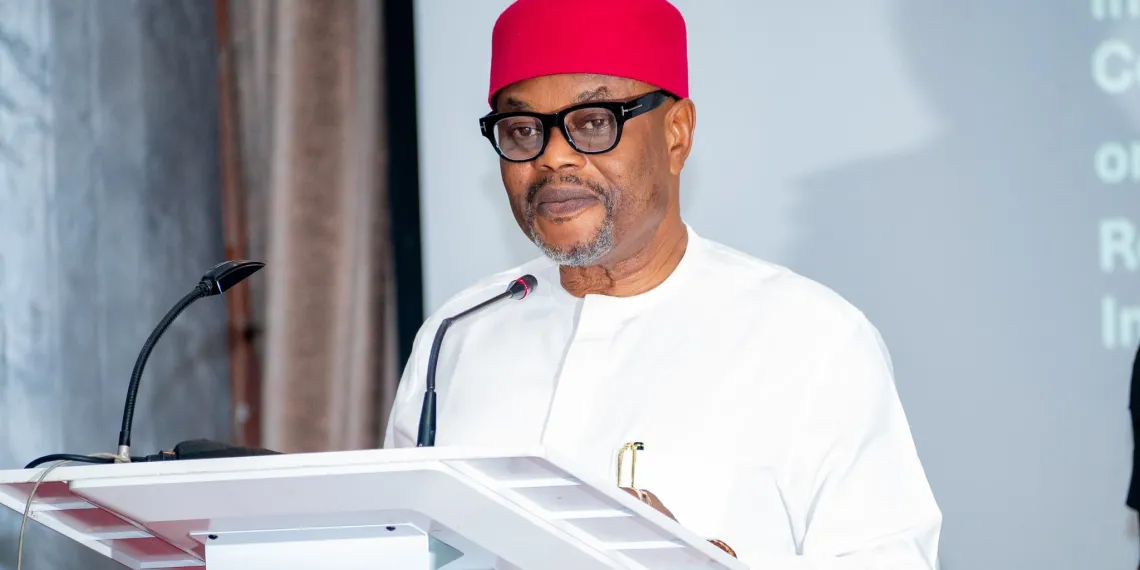
Chief Uche Geoffrey Nnaji, the Peoples Democratic Party (PDP) governorship candidate in Enugu State, has commended residents for speaking out against the proposed disposal of some state-owned assets, warning the government against transferring public property without transparency and adequate scrutiny.
Nnaji, a former Minister of Innovation, Science and Technology, said the widespread public reaction to the proposed exercise demonstrated that Enugu residents were increasingly prepared to hold the government accountable over the management of their collective assets.
In a statement titled, “The Voice of the People Has Prevailed,” Nnaji said public assets belonged to the people and should not be treated as the private property of any administration.
“Government is a trustee, not an owner,” he said.
The PDP candidate was reacting to reports concerning the proposed disposal of assets linked to the Enugu State Broadcasting Service (ESBS), Enugu State Water Corporation, Nnamdi Azikiwe Stadium and the Enugu State Liaison Office in Lagos.
Nnaji said the controversy should also be viewed against previous private-sector arrangements involving state assets, including Nike Lake Resort, Hotel Presidential, Enugu United Palm Products Limited and Sunrise Flour Mills.
While acknowledging that Public-Private Partnerships could attract investment and revive underperforming assets, he warned that PPP arrangements must not become “a cover for secrecy” or a means of transferring valuable public property without sufficient scrutiny.
According to him, before any strategic state asset is sold, leased or concessioned for decades, the government should disclose its independent valuation, previous public investment in the asset, reasons for the proposed transaction, beneficiaries, financial returns to the state and the duration of private control.
“What will ultimately remain in the ownership and control of the people of Enugu State?” Nnaji asked.
He also questioned what future generations would inherit where agreements involving public assets extend far beyond the tenure of the governments that executed them.
Nnaji praised traditional rulers, professionals, youths, civil society groups, community leaders, traders, the media and other residents who raised concerns over the proposed exercise.
“Ndi Enugu are watching. Ndi Enugu are asking questions. Ndi Enugu will no longer surrender their patrimony in silence,” he said.
The former minister also pledged that, if elected governor in 2027, his administration would not sell, concession or place strategic state assets under long-term private arrangements “behind closed doors.”
He promised that transactions requiring private capital would undergo competitive and transparent processes, including independent valuation and clear demonstration of the economic benefits to Enugu residents.
“We will welcome private investment, but private investment must serve the public interest. We will not mortgage tomorrow merely to finance today,” he said.
Invoking the industrial legacy of former Eastern Region Premier, Dr Michael Iheonukara Okpara, Nnaji argued that governments should concentrate on creating new productive assets rather than merely disposing of inherited ones.
“The measure of a government should not be how many inherited assets it can dispose of, but how many new assets it can create for the next generation,” he said.
He urged residents to continue demanding transparency and accountability from those entrusted with managing the state’s resources.
“Governments will come and governments will go. But Enugu is our inheritance — and Enugu must endure,” Nnaji added.