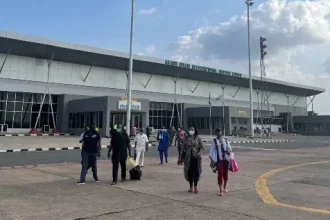
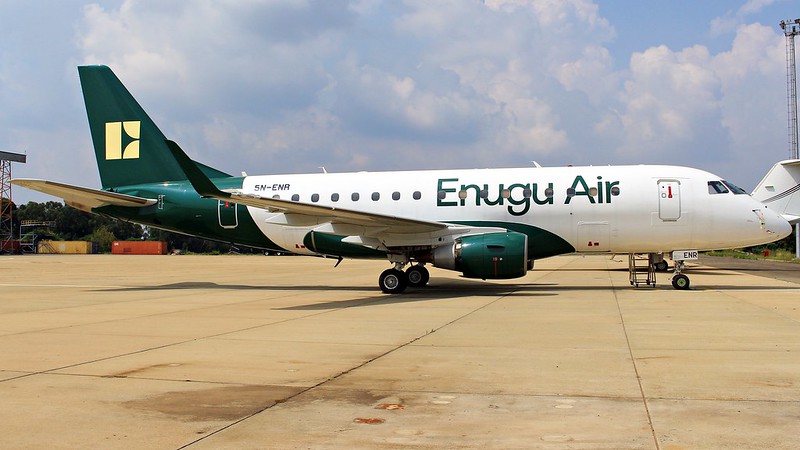
Enugu officials celebrated Enugu Air’s maiden international flight to Douala, Cameroon, with singing, dancing, speeches and grand claims about trade, tourism, investment and regional integration.
In a state where almost every government project is described as “smart,” however, the public saw little evidence of smart commercial planning. What they saw looked more like an owambe in the sky: government officials, commissioners, media aides, invited dignitaries, photographs and extravagant declarations.
What they did not see were the agreements, figures and safeguards needed to demonstrate that this publicly financed route makes commercial sense.
No cargo agreement has been disclosed. No export contract involving Enugu businesses has been announced. No investment partnership or joint tourism programme has been identified. The government has also not published the route’s expected operating costs, projected revenue, passenger-demand study, break-even passenger numbers or public subsidy.
Even more striking was the apparent absence of officials directly responsible for trade, investment and tourism, the very sectors the flight was supposedly launched to promote.
Their absence does not prove that no planning took place. It does, however, raise a legitimate question: was this route launched as part of a serious economic strategy, or was it mainly another government publicity event?
Where Is the Commercial Plan?
If the Douala service is genuinely intended to promote trade and investment, Enugu people should be shown the exporters, manufacturers, freight companies and investors committed to using it.
If tourism is part of the plan, the government should identify the hotels, travel agencies, tour operators and tourism packages supporting the route.
So far, the public has received speeches and slogans, but little evidence of concrete commercial arrangements.
Enugu Air is not a private business in which promoters alone bear the risk. It was established by the Enugu State Government on behalf of the people and was reportedly financed partly through borrowing. If the route fails to generate sufficient passenger and cargo revenue, who pays the difference?
Will Enugu Air absorb the losses, or will the state subsidise tickets, fuel, airport charges, ground handling, insurance and empty seats?
The aircraft may carry the Enugu Air name, but the financial risk may ultimately belong to Enugu taxpayers. Transparency is therefore an obligation, not a favour.
A Short Flight Is Not an Economic Revolution
Enugu and Douala are approximately 360 kilometres apart in a straight line, while Enugu and Lagos are about 470 kilometres apart. The Douala service is therefore a relatively short regional flight.
A direct connection may benefit passengers who would otherwise travel through Lagos, Abuja or Port Harcourt. But convenience is not the same as economic transformation.
A short flight does not automatically become a major trade corridor simply because officials describe it as “international,” “historic” or a breakthrough for regional integration.
The trade argument also deserves scrutiny.
Nigeria reportedly exported goods worth about $131 million to Cameroon in 2024, with scrap vessels and cement among the major products. Neither provides an obvious business case for a 76-seat passenger aircraft.
Scrap vessels cannot be carried in an Embraer E170, while bulk cement is not normally transported as passenger-aircraft cargo. Enugu is not a major source of Nigeria’s scrap-vessel exports and has no major cement factory producing for export to Cameroon.
The real question is straightforward: what products from Enugu or neighbouring states will be exported to Cameroon by air, and which businesses have committed to using the service?
Until the government answers that question, citing Nigeria’s total trade with Cameroon remains a public-relations argument, not proof that an Enugu to Douala route is commercially viable.
Cameroon May Gain More From Tourism
The government has also promoted tourism as a major benefit of the route. Yet it has not explained why significant numbers of Cameroonian tourists would visit Enugu, which attractions are being marketed to them, or what tourism packages have been created.
Cameroon already offers established destinations such as the beaches of Kribi and Limbe, Mount Cameroon, wildlife parks, rainforests and waterfalls.
The direct flight may therefore make it easier for Enugu residents to holiday and spend their money in Cameroon.
Without a deliberate strategy to attract visitors in the opposite direction, Cameroon could gain tourists and their spending while Enugu taxpayers carry much of the airline’s financial risk.
Permanent Route or Christmas Experiment?
Information published before the launch reportedly showed two weekly flights on Mondays and Wednesdays, using a 76-seat Embraer E170. The schedule extended only to October 28, 2026.
Is this a permanent service, a short-term commercial trial, or an attempt to test the market ahead of the Christmas travel season?
There is nothing wrong with testing a new route. Airlines do it regularly. The problem arises when public resources are committed to a commercial experiment while the project is presented as an established economic triumph.
If the route is a trial, the government should say so clearly and disclose the targets by which its performance will be measured.
Publish the Figures
Reports surrounding the establishment of Enugu Air indicated that aircraft financing involved Fidelity Bank, while XEJet serves as an operating partner. However, the complete financing and operating arrangements have not been made public.
Borrowed money is not free money. Every naira spent servicing debt or covering airline losses is money unavailable for hospitals, schools, water, security and roads.
The government should therefore disclose:
- how much was borrowed;
- what public guarantees support the financing;
- how profits and losses are shared;
- the projected cost and revenue of the Douala route;
- the expected passenger load factor and break-even point;
- who pays if passenger and cargo revenue falls below expectations; and
- any cargo, investment and tourism agreements supporting the service.
These are not hostile questions. They are basic questions any responsible investor would ask before committing money to an airline.
Enugu people are not spectators at a government aviation show. They are the airline’s ultimate stakeholders and may ultimately be required to bear its financial obligations.
They deserve to know whether Enugu Air is pursuing a credible commercial opportunity or whether public money is financing an expensive “smart owambe” in the sky.