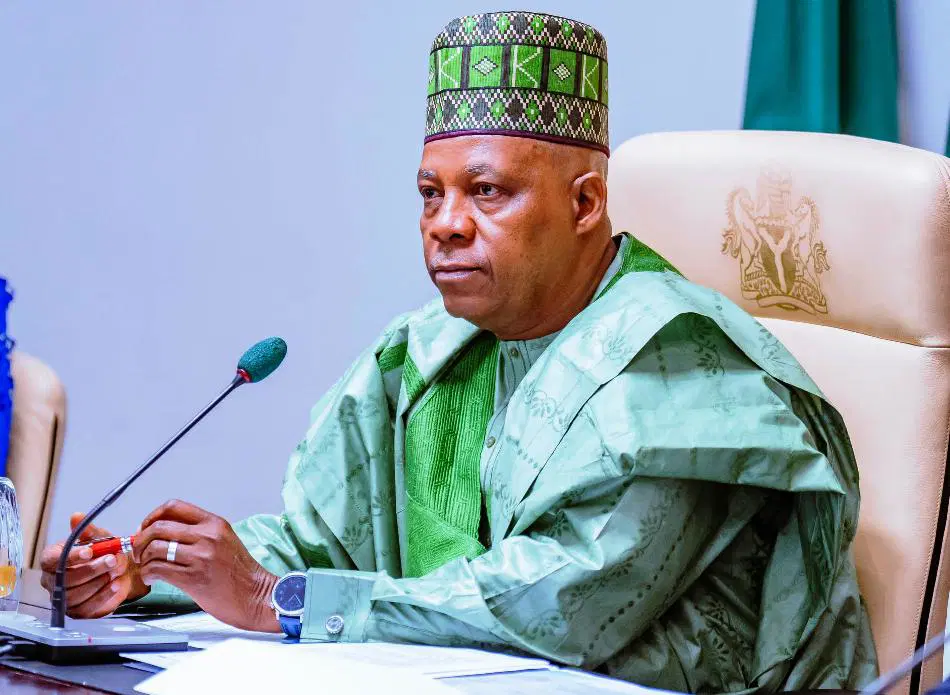
Vice President Kashim Shettima has declared that Nigeria’s ambition of becoming a $1 trillion economy cannot be realised without strong corporate governance, regulatory discipline and institutional accountability.
Speaking at the 3rd National Corporate Governance Summit organised by the Institute of Directors Centre for Corporate Governance (IoDCCG) in Lagos, Shettima said sustainable economic growth depends on ethical leadership and strict compliance across both the public and private sectors.
The summit, themed “Implementing Good Governance for Economic Acceleration, Consolidating Public-Private Partnership,” was organised in collaboration with the Financial Reporting Council (FRC), the Ministry of Finance Incorporated (MOFI) and the Institute of Chartered Secretaries and Administrators (ICSAN).
Represented by the Special Adviser to President Bola Tinubu on Economic Affairs, Tope Fasua, the Vice President said the summit’s theme aligns with the Federal Government’s Renewed Hope Agenda, which seeks to drive inclusive economic transformation through institutional reforms and private sector participation.
Shettima noted that while the administration has introduced key economic reforms aimed at creating a stable macroeconomic environment, achieving a $1 trillion economy will ultimately depend on effective governance practices. He cited major policy measures such as the removal of fuel subsidy, foreign exchange harmonisation and the restructuring of strategic sectors as reforms designed to strengthen the economy.
According to him, the responsibility now rests with the private sector to convert these policy reforms into investments, job creation, increased production and long-term national wealth. He stressed that weak compliance, poor regulatory enforcement and unethical business practices could undermine Nigeria’s economic aspirations if left unaddressed.
The Vice President observed that Nigeria already has an extensive legal and regulatory framework supporting corporate governance, including the Nigeria Code of Corporate Governance, the Companies and Allied Matters Act (CAMA) and industry-specific codes issued by regulators such as the Central Bank of Nigeria (CBN), National Insurance Commission (NAICOM) and the Securities and Exchange Commission (SEC).
Despite these frameworks, he said the country has experienced numerous corporate failures driven by insider abuse, creative accounting practices and reckless risk-taking rather than a shortage of innovative ideas. Shettima added that the Federal Government is complementing private sector reforms through improvements in state-owned enterprises, public procurement reforms and the digitisation of government processes.
Also speaking at the summit, the Managing Director and Chief Executive Officer of the Ministry of Finance Incorporated (MOFI), Dr. Armstrong Takang, said state-owned enterprises remain critical to Nigeria’s economic transformation.
He rejected the argument that governments should avoid participating in business activities, citing China as an example where central government-owned enterprises control assets valued at approximately $13 trillion while playing leading roles in infrastructure, manufacturing and technology.
Takang maintained that properly governed state-owned enterprises can significantly contribute to achieving Nigeria’s $1 trillion economy target.
The President and Chairman of the Governing Council of the Institute of Chartered Secretaries and Administrators (ICSAN), Mrs. Uto Ukpana, described good governance as a strategic requirement rather than merely an administrative obligation. She argued that although Nigeria possesses numerous policies, sustained economic progress depends on effective implementation supported by ethical leadership, regulatory consistency, transparency and accountability.
Similarly, the Chairman of the Board of Governors of the IoD Centre for Corporate Governance, Mr. Urum Kalu Eke, said entrenched corporate governance strengthens institutions, boosts investor confidence and creates the conditions necessary for long-term economic development. According to him, stronger governance standards will enhance accountability and position Nigeria for sustainable growth as it pursues its long-term economic objectives.